Showing posts with label Fuzz. Show all posts

Monday, 2 January 2023

Devi Ever/Dwarfcraft Devices Super Soda Meiser

This one was recently traced on FSB and as i have a soft spot for Devi & Dwarfcraft circuits alone and together, i had to draw it up.. A bit like original Soda Meiser, or at least some revisions of it, but this time with a Chaos switch and a Drone-knob.


Dylan159's Boot Fuzz

2023. How the heck are we still alive.. No matter. Let's do another layout or two. This time, another nice, loud little circuit from Dylan159's Unrealeased Circuits - From the source:
Boot Fuzz. I found this simple old-school microphone preamp, and noticed the similarity with the Fuzz Face, also claimed to be based around a microphone preamp, but in this case the second stage is an emitter follower bootstrapping the load of the first for big gains. So I thought why not fuzzing it up by increasing the gain? This ends up being similar to an Escobedo circuit, but with a different, more stable biasing. 


Thursday, 15 December 2022

DNA Analogic Smoky Fuzz

 Traced on FSB by Asbestosaurus, this circuit looks at a first glance a bit like OD250/Dist+, but no. And the Sense control makes this quite interesting. I built my layout version one, but this is redrawn to make it better.. Anyway, nice to see something cool done to a single opamp drive topology.


Monday, 5 December 2022

Lastgasp Art Laboratories Green Monster Septic Fuzz

 Found this circuit from the DEFX files and thought this to be quite interesting. Discontinued circuit with noise for days. From the source:

The GREEN MONSTER septic fuzz (GM2)is an effect
pedal to create a septic distortion.

Characterized by a dirty, broken and rotten sound. Bad handling!

GREEN MONSTER is back with four knobs! There is an easy to use sound which the first GREEN MONSTER (ultra fuzz) was never able to create, but the sound is still putrifying! Genuine septic sound can be found here!


First one is close to the original...

 ...and the latter is with DEFX mods - adding a gain switch for stock and other...


Thursday, 1 December 2022

Dylan159's Fuzz Facelift

 It's december already!

From Dylan159's Unreleased circuits on FSB:
I'm not done with fuzz faces it seems. This one's goal is to keep all the classic cranked gain tones while making the ill-treated gain knob more useful. This is accomplished by moving the gain control to the first stage. When maxed, you have a classic, low input impedance, high gain fuzz face, because the emitter is effectively grounded. At low gain, the input impedance rises to something close to 200k or more, hopefully giving an interesting sound without the usual dulling that happens. Last but not least, this one doesn't need trimming! the emitter resistor assures predictable bias even with widely differing beta. You can still make it adjustable if you like to mess with it. Care has been taken to avoid blocking, since we're adding capacitors. With these values, blocking is roughly the same as with the original.

Update: Oops. There was a cut missing from the fuzz 3 + 100µ cap.. 8.12.2022, now fixed... and verified.


Sunday, 13 November 2022

YACK YF-2 Fuzz

George Giblet did a trace (and some guesswork on the cap values) on FSB a few years back. The cap values might not be 100% per original, but according to George, those should be at least close enough. There are a few ideas on this late 60's circuit that are not present on every single FF/TB-clone out there, so i thought this migh be nice and fun little circuit to try out. Not sure if i built one back when this was drawn. Seems i can't remenber everything that went on in 2019. Seems so long ago now.

However. This might be fun to build and to tweak to your liking. Note the transistor pinouts as those match 2SC828s. Parallel polarity protection is in place etc. I'm fairly certain you'll get this sounding good with modern values for resistors as well.


Monday, 3 January 2022

Earthquaker Hizumitas

 From the source:

The Hizumitas was designed for the one and only guitar sorceress, Wata, from the legendary band, Boris! We could not be more excited to have the honor of working with such an iconic legend known for her crushing riffs and mind-melting leads. The Hizumitas is a faithful sonic recreation of her go-to distortion which has been a staple of her tone for many years: the Elk BM Sustainar.

Despite the claims it's not a 1:1 clone of the original, as there are some changes, but who doesn't love a BMP variant. The only change from the schematic is I included a polarity protection diode and 100uF filtering cap in place of a 100r resistor from +9V to the power rail. If you want to include it swap out D3 for a standing 100r resistor. Build on fellow followers of the fuzz.


Stock:


With added Mid Switch:


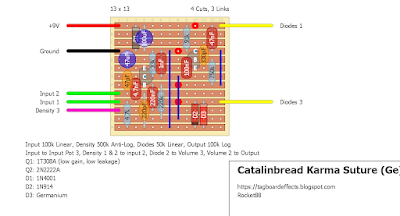
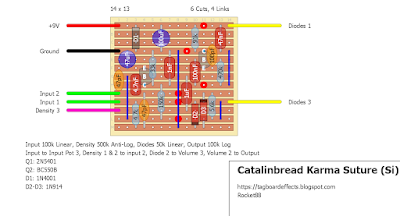
Catalinbread Karma Suture

Catalinbread has released two versions of the Karma Suture, one germanium and one silicon based. Both at their hearts are simply a modified Harmonic Percolator. I think Catalinbread described it best on their site:

A bubbling cauldron of even-order harmonics!

The only change I made in the layout from the schematic is I added a 100uF cap from power to ground to assist in power filtering. Schematic can be found here. Enjoy my fellow fuzzheads.

Catalinbread Karma Suture (Ge)


Catalinbread Karma Suture (Si) 


Wednesday, 2 September 2020

Dinosaural Tube Bender

In October 2003, Dan Coggins (formerly of Lovetone) released his first commercial pedal under the Dinosaural brand, called the Tube Bender. His design goal was to make something that was sort of a tonal hybrid of the Tone Bender and Tube Screamer, hence the name. And honestly, having listened to it, I’m not sure there’s a better way to describe it. He only made around 140 of them between 2003 and 2007, but many of them were snatched up by musicians and producers in the UK. So while they’re exceedingly rare, you’ve most likely heard it.


I added a mod from the AION Wyvern Silicon Drive of  a second position to the Tone Shift switch that’s in-between the flat and scoop modes. I've included the hfe readings from an original pedal as per Aion's trace, so you can try different transistors with similar gains. 


It's so rare I couldn't find a demo of it, but I think you get the gist of what it should sound like. 


Wednesday, 29 July 2020

Third Man Records Bumble Buzz

From the Source:

The Bumble Buzz Pedal, HAND MADE by Chris Young of Union Tube & Transistor (who built the pedal used for Jack White's guitar sounds on "Sixteen Saltines" and the vocals on "I'm Shakin'" off of 2012's Blunderbuss), is ready for buzzing around and stinging sounds. Designed by Third Man Creative Hive.

Input impedance: Zin @ 1KHz 30K / Output impedance: Zout @ 1KHz: 33K.

Essentially it's just a modified Kay F1 Fuzztone, which itself was just a simplified Univox Super Fuzz.


Friday, 24 July 2020

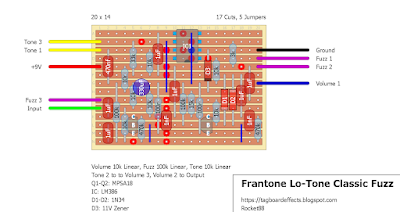
Frantone Lo-Tone Classic Fuzz

From the source:

At last... a classic fuzztone for bass!  This transistorized beauty uses germanium diodes for soft knee clipping and actually boosts the bottom to give you awesome sustain with rich creamy fuzztone.  Wonderful overtones and plenty of thump to boot.   


Sunday, 12 July 2020

Earth Sound Research Graphic Fuzz


This is one of my favorite bizarre and unique fuzzes of all time. Gnarly, spacey, heavy, and broken. Nothing else sounds like it.

Induction on the forum a long time ago talked about how to make it so you can daisychain this beast, because you couldn't with the original. I found floating around in my files a schematic with the modification, so I figured why not just whip up a board.


Earthquaker Devices Black Ash

From the source:

Limited to 1500 units worldwide, Black Ash is a fuzz/overdrive that takes some cues from the vintage “three-knob Bender.” It uses a highly curated cache of rare and irreplaceable components including paper-in-oil capacitors and NOS half-watt carbon composition resistors from EQD President Jamie Stillman’s personal stash to light a fire under this classic fuzz/drive with an explosive-yet-detailed treble response, a sturdy midrange, and subterranean bass extension.
  1. Fuzz: Adjusts the amount of gain. Counterclockwise for less fuzz, clockwise for more fuzz.
  2. Top: Adjusts high frequencies between 2kHz - 10kHz and controls how “forward” the guitar sits in the mix. Counterclockwise for less top, clockwise for more top.
  3. Level: Sets the output volume. Counterclockwise is quiet, clockwise is loud.

     It's essentially a modified silicon tonebender.


    Stock:


    External Bias:


Friday, 10 July 2020

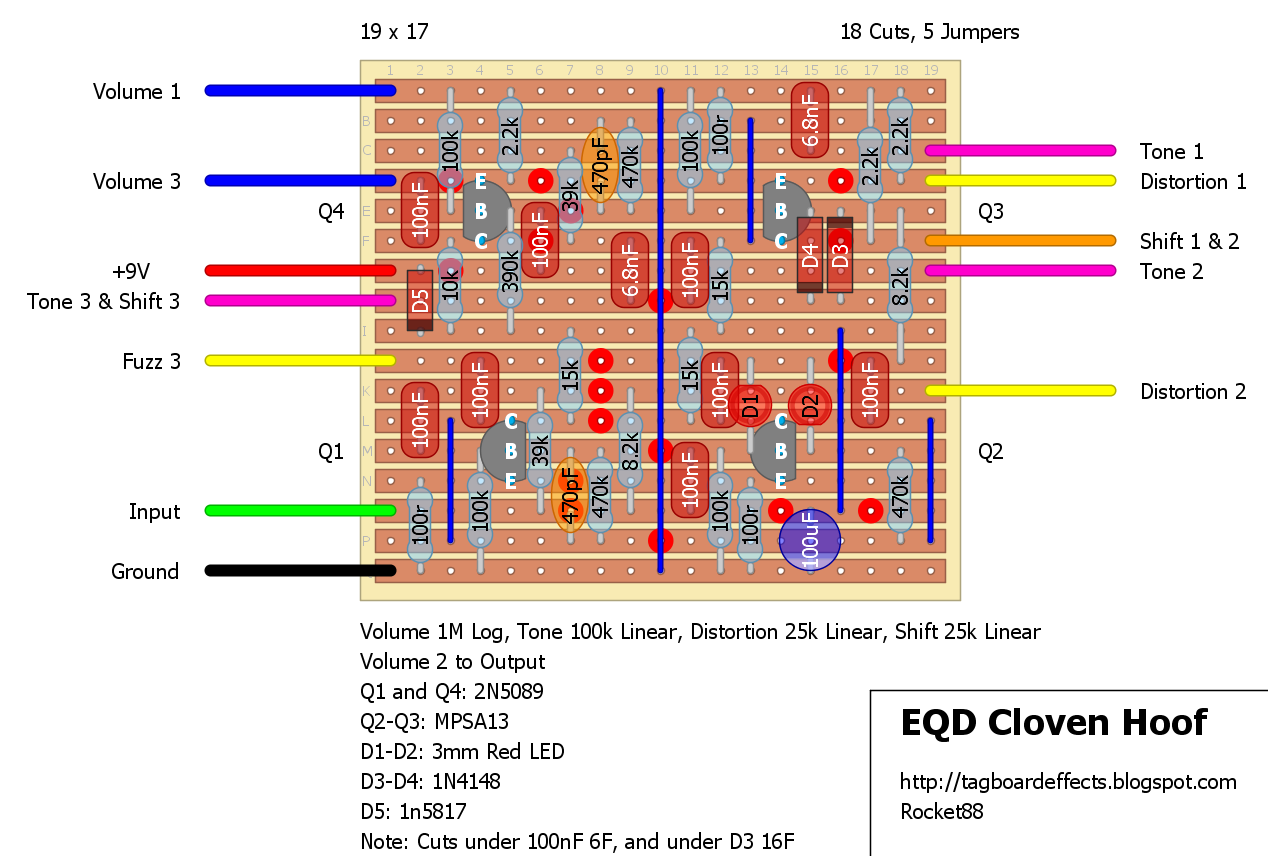
Earthquaker Devices Cloven Hoof V1


Sorry for such a long delay in publishing some new layouts, there's been a lot of changes going of for me which has taken up a lot of my time to sit and make some new layouts. Shortened version: became a doctor, had my first child with my wife, got a new job practicing, lots of home projects around the house, and COVID. Here's the first of many new ones from me coming at you. Figured I'd start with something familiar to all the fuzz lovers out there, as you can never have enough muffs.
 
From the Source:

The Cloven Hoof is an extension of Earthquaker Devices popular Hoof fuzz, only more… cloven. Earthquaker kept the clarity of the Hoof along with the wide range of dirt tones and redesigned everything around it. The Cloven Hoof delivers a grittier, more bass heavy tone with more crunch that can not be achieved with the standard Hoof. They did away with the germanium transistors and replaced them with 4 specially selected silicon transistors for higher gains, cleaner cleans and improved temperature stability. The fuzz control has four times the range of the regular Hoof, it will go from completely clean to an all out fuzz fury with more grind at the top end of the dial. The tone control has been refined to allow a more even sweep with enough mids to handle all the additional low end. The shift control still boosts or cuts the mids and there is still a TON of output on tap. The Cloven Hoof is the perfect solution for those of you who always wished the Hoof had more. Each Cloven Hoof is made by hand in the majestic mountain top village of Akron, Ohio.

Controls

Fuzz: Clockwise for heavy, counterclockwise for light.
Tone: Bass to the left, Treble to the right.
Level: Use this control to make the Cloven Hoof louder or quieter.
Shift: This adjusts the mid content, clockwise for scooped mids, counterclockwise for boosted.


Friday, 21 June 2019

Fuzzrocious Ram the Manparts


From the source:

Ram The Manparts is a LM386 (a power amp chip) overdrive that we built to allow guitarists and bassists to not only drive an amp HARD, but also to add some textures and features to stand out! The voltage sag allows the user to drop the voltage below 9V, creating a glitchy, sputter, Velcro-like sound. Keep it clean, make it grindier/heavier, or make it glitchy…the choice is yours, dude. 

The pedal has since been discontinued and not the cheapest when buying used if you can find them.

On Guitar:


On Bass:


Friday, 22 March 2019

Creepy Fingers EQ/Exciter

Brad of Creepy Fingers posted about his build of the old SRS EQ/Exciter pedal with a little mod to allow for gain control. The SRS EQ/Exciter is basically a Fuzz Face with a buffer and a mid control. All I can say is this thing sounds HUGE!!!!

Sound clip


Thursday, 14 March 2019

Anta Fuzz

First post of the new year. This comes from a request posted in the forum. Not much I could find about this other than it's a Fuzz Face derivative made in the 70's in the USSR.


Tuesday, 25 September 2018

Elk Muff Sustainer

Description from the Big Muff Page

Among the many Japanese Big Muff clones, one of the first on the market was the Super Fuzz Sustainar, a nearly exact clone of a 1972 era Big Muff made by the Hoshino Gakki company (early units possibly made by Miyuki Ind. Co.) sometime around 1973. It was housed in an identical enclosure to the V1 Big Muff with very similar graphics. These were sold throughout the 1970s, and not long after its introduction, Gakki shamelessly changed the name from Super Fuzz to Big Muff. The pedals marked Electro Sound are the earliest, and those marked Elk Incorporated or Elk/Gakki are the later made production. 

The circuit is identical to a PNP triangle circuit from 1972, almost identical to the PNP circuit shown above. The only change made was the high pass cap in the tone section at C9. Typically .004µF, it was changed to 330pF in the Sustainar. This had the effect of retaining treble when the tone pot was turned to the bass side, making the bass range more useful. When fully in the bass position the overall volume level is significantly higher than other tone settings as well.


Note: this effect is PNP, positive ground, and you will NOT be able to daisy chain this with normal NPN, negative ground, effects unless you add a negative voltage inverter board.

With requested Mids Switch

Saturday, 15 September 2018

McSpunckle Gnomeratron VTF

This was a request.
You could use external pots instead of trimmers.
Schematic available here.


Sunday, 11 February 2018

Deluge Bass Distortion

Spotted this over at General Guitar Gadgets and thought it sounded nice. It's a modified
big muff that supposed to be tuned for bass, and from the clip it sounds pretty nice, but then again how can you go wrong with anything with big muff origins.