Here's a collection of vero (stripboard) and tagboard guitar and bass effect layouts that we have put together covering many classic and popular effects in growing numbers. Many of these have been posted on freestompboxes.org, so check that site out for great discussions on building your own effect pedals. Enjoy the builds and please also visit us on Facebook and Twitter
Info:
"Inspired by the Trainwreck Express amplifier (built by the late Ken
Fischer), the TWE-1 is solid-state pedal designed to emulate the
touch-responsiveness and clean-to-overdriven range you get from a
high-grade tube amp. Along with Volume, Hi Cut, and Gain controls, the
pedal has 3-position Cab switch (4x12, 2x12, off), a Presence switch
that provides three levels of high-frequency boost (post OD), a Voice
switch (Traditional and Modern British), and a bypassable Brite switch
that provides two levels of high-frequency boost (pre OD). The TWE-1 with its Gain at noon or higher responded in an amp-like way to
changes in guitar volume and picking strength, delivering everything
from gritty cleans to richly saturated distortion textures. Thanks to
its strong output, the TWE-1 is suitable for clean boosting too. All
good stuff, but the standout feature of the TWE-1 is its powerful
tone-shaping ability. The Hi-Cut knob attenuates treble when turned
clockwise, and the Brite switch makes it easy to get the appropriate
sparkle with humbuckers or single-coils. The Cab switch beefs up the
low-end significantly in the 4x12 position (I felt the 2x12 setting
sounded best with my Deluxe), and the Voice switch lets you choose
between a thicker tone in the “M” position or one with more
upper-midrange emphasis in the “T” setting. The Presence switch set to
Hi restores shimmer when the Hi Cut control is turned up (a cool sound
in itself), and between all of these functions, the TWE-1 certainly
answers the needs of players who want a compact OD pedal with
exceptional sound and flexibility."
The layout should fit in a 125B size box.
You can find Bugg's schematic and easier-to-build pcb on his website here.
This is a buffered effect. Follow the layout to connect the footswitch.
Original info:
"The Steel String Clean Drive faithfully recreates the tonality and feel
of the iconic Dumble Steel String Singer amplifier in a stompbox format.
Designed alongside a real Steel String Singer (#001), this 100% analog
tone tool will do it all from Overdrive, to Fat Boost, to Compression,
to EQ shaping and more. Get the unmistakable Crystal-Clear Overdrive
and Fat Clean Tones from albums like "Texas Flood", "Venus Isle", and
"Continuum" through any clean amp platform"
You can find Bugg's PCB and schematic here.
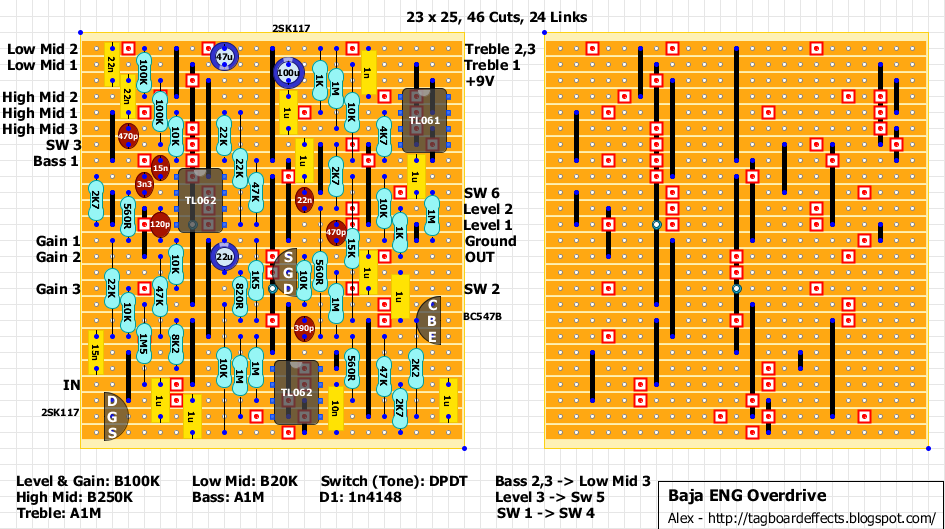
Bajaman's overdrive circuit based on the Engl 530 preamp with switchable tone stack.
Original thread and schematic available on the FSB forum here.
The layout should fit in a 125B box.
09/07/2018 Layout Updated! Inverted Treble and Bass pots' lugs. Changed 390p cap from TL062 pin 5 to 470p. Changed 1K resistor next to 22uF cap to 1K5.
22K resistor between Gain 1 and Gain 3 goes from Gain 1 to 15n/10K 3 rows below instead of Gain 3. 22K above TL062 pin 8 needs to move down one row between 10K/22K and VBias.
Bajaman's overdrive/distortion circuit based on the Mesa Dual Rectifier high gain channel with switchable tone stack.
Original thread and schematic available on the FSB forum here.
The layout should fit in a 1590B box.
This is based on a Marshall JVM410.
You can find Bajaman's original thread and schematic on the FSB forum here.
There are two versions:
First one with just one toggle switch to select between Cruch, OD1 and OD2.
The second one uses separate footswitches, Gains and Levels.
You need to add an extra pole for LEDs.
Can use any small signal N channel JFet for the buffers (mind the pinout).
What can I say about the Laney Supergroup. The supergroup was based on the same Fender Bassman architecture just
like the Marshall JCM800, Sunn Model T, Mesa Dual Rectifier, and a whole host of other
legendary Rock, Hard Rock, and Metal amplifiers. One of the best descriptions I've ever heard of the Supergroup is that it's like a Marshall JCM800 with more balls and gain. It's just an all around badass heavy amp. And for all my lovers of tall things heavy it was used by the legendary Tony Iommi for years, and Laney even went through the trouble of recreating it to reissue it as a special signature amp for Iommi.
"A boutique pedal homage to the unique onboard overdrive circuit in
vintage solid state Vox Conqueror amps that George Harrison used on the
White Album and other Beatles recordings. The White Pedal has four
knobs that control volume (overdrive), gain (fuzz), treble cut, and a
bass cut knob that acts as a mid-boost, while a fifth knob (the Yoko
knob) selects the midrange frequency to boost for a parked wah sound"
Original FSB thread and schematic available here. Schematic should be correct but it's not verified yet.
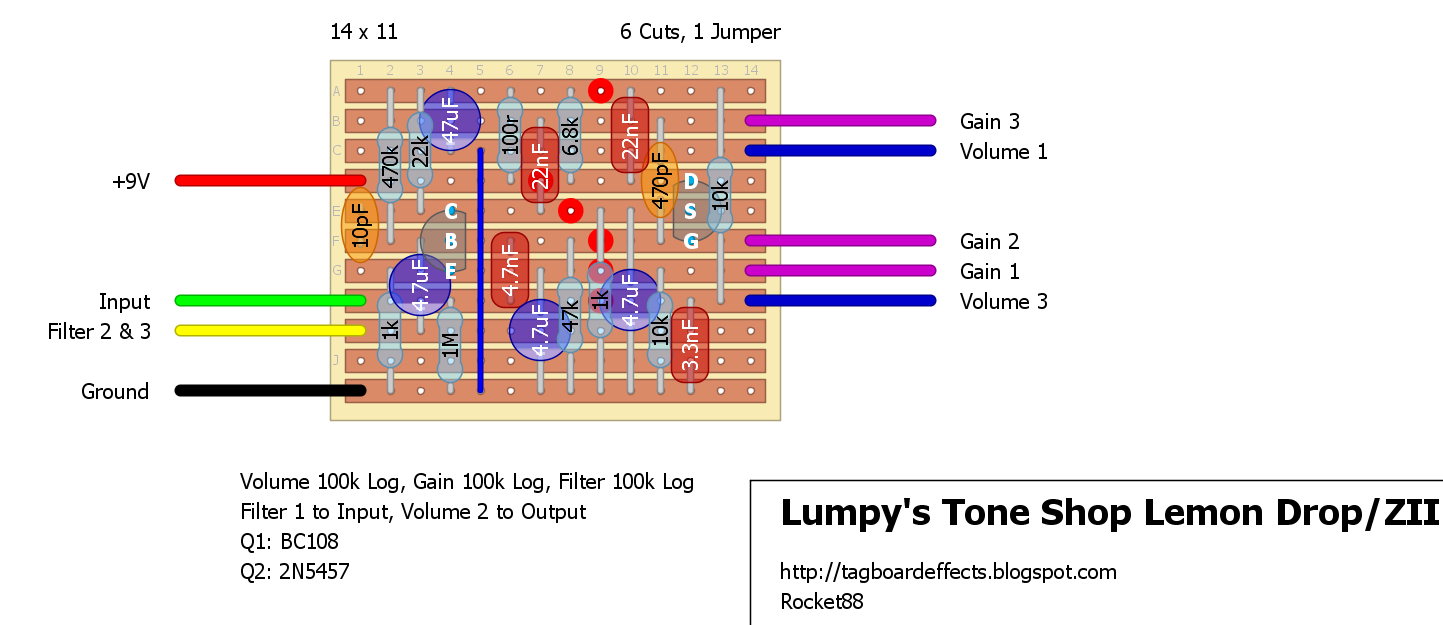
Originally sold as the Lemon Drop, then the ZII, and now the Series 7.
Description of the Series 7 from the source:
Designed to mimic the unique overdriven tones of the rare Vox 4&7
series amplifiers in a small and easy to use stompbox. An unknown amp
to most, the 4&7 series amps were most famously used by the Beatles
during the Revolver era and Jimmy Page on numerous tracks from
the second Zep album. Think Paperback Writer style of tones and,
yes, Whole Lotta Love.
The 7 Series Overdrive captures the
aggressive qualities of the solid state preamp found in the 4&7
series amps by using a pseudo hybrid setup consisting of a specifically
selected silicon transistor for the first stage which adds a distinct
bite and growl. That pushes an FET stage into clipping adding some
warmth, sustain and amp like dynamics to the tone and feel. The end
result is a highly effective emulation of the amp and a unique sonic
blend that could be characterized as a "fuzzy overdrive."
As it's been pointed out there are some pictures with the 2.2uF coming off the emitter to ground as 4.7uF. I've seen pictures with 2.2uF as well, so I'm under the assumption that there's multiple versions as the pedal has changed names over the years. I changed the value of the cap so now there's 2 different layouts. With the 4.7uF cap the pedal should fatten up more compared to the 2.2uF.
Up next in the tube preamp series, I give you the Orange AD200B MkIII. This is the current production AD200B, which has a few changes compared to the MkI, which is why I figured it would be a good idea to make a layout for this version as well. Similar to the MkI, the MkIII is known for great clean, with a focused
midrange, but has great grit with the gain cranked.
Unlike
the Sunn Model T, this has not been breadboarded and tested out, I just
followed the same concepts Ciaran and I used to convert the Model T
preamp to use FETs. This means at this point, there may need to be some
tweaking to component values to get it just right.
Edit: Putting this on hold until i can get some time to breadboard it and get it sounding right.
Up next in the tube preamp series, I give you the Orange AD200B MkI. Made in very limited numbers, only a few hundred if that, in 2001 these were made P2P on turretboard. Known for great clean, with a focused midrange, but has great grit with the gain cranked.
Unlike the Sunn Model T, this has not been breadboarded and tested out, I just followed the same concepts Ciaran and I used to convert the Model T preamp to use FETs. This means at this point, there may need to be some tweaking to component values to get it just right.
One thing to note, as I didn't put it in the build notes. All the pots are dual gang pots, with each corresponding lug connected. What this means is lugs 1a & 1b are connected together, 2a &2b are connected together, and 3a & 3b are connected together.
Edit: Putting this on hold until i can get some time to breadboard it and get it sounding right.
For those that don't know I'm a huge lover of low end, and a worshiper of all things Sunn, in fact I've designed a turretboard layout to build a 1st Gen Sunn Model T ready to go as soon as I have the time to build it, which since I'm getting my Doctorate won't be for 3yrs.
But, I digress. With all these new FET amp in a box pedals out now, I've yet to see any that are based on the amps I've lusted after. So, with the help of Ciaran, who did the majority of the grunt work, I bring you the first in what will be a series of amp preamps converted to FET pedals that he and I are going to be working on.
Unlike, the Earthquaker Acapulco Gold, which falsely claims to emulate the Model T, this monster is a true Model T preamp, minus the presence pot. You get both the Normal and Bright channels, as well as the ability to jumper both together just like the real deal.
The 1st gen Model T was based on the old Fender Bassman, but has much more low end, and nice tight focused grit. It's never truely clean. Now the real magic happens when you put the right booster in front of it, or a fuzz/distortion pedal like a rat or big muff.
Example of someone just messing around, low gains too. :)
Example of one Hovercraft did a tube job on with a Catalinbread Manx Logathian (BMP Variant)
Example of the amp with Distortion Pedals
For those curious what the peamp itself sounds like as opposed to the original amp, here's a really short video of this preamp in a home built 100watt solid state mini model t I built. The preamp is being run at 24V, and both channels simultaneously, so there's no switch between channels. The gain for both channels at noon, master volume at like 2 o'clock, then used a modded Ross distortion I make that's heavily modified for
more low end, and an active Bandaxall tone stack. I ran it through my Ampeg SVT210AV (2x10 bass cab), and audio & video from my iPhone. I'm playing my Les Paul tuned to C-Standard with a Seymour Duncan Pearly Gates in the neck and JB in the bridge, but using the neck pickup only.Ignore the crappy playing I'm a bassist not a guitarist.
Layout 1:
Layout 1 Gain Mod: For those that don't want the gain pots to be able to cut off the output completely I've tweaked the layout to match Ciaran's suggestion of adding a 100k resistor to ground from lug 1 of both gain pots. Stupid easy mod if you've already built the regular layout.
Layout 2: 2nd tonestack wiring, exactly as the amp. note that both wiring options will act the same as it's a modified fender/marshall/vox tonestack
Layout 2 Gain Mod: For those that don't want the gain pots to be able to
cut off the output completely I've tweaked the layout to match Ciaran's
suggestion of adding a 100k resistor to ground from lug 1 of both gain
pots. Stupid easy mod if you've already built the regular layout.
Thought i'd post this here too in case someone wants to try it out. There's an old development thread on FSB for this AC30 emulation circuit. There are number of schematic versions with slight differences, but the basics are the same for all of them. It is a nice high gainer with some noise content, so i'd suggest using 220µ for the power filter and maybe adding a 100p cap between germanium transistor's base and collector. I built one to see if the layout works and it's good to go.
Here's a challenge for those who want theirs in 1590B. Should fit, but it'll be a challenge.
From ROG: The English Channel was our first attempt to adapt the Vox AC-30 Top Boost amplifier for use as a guitar pedal. Released in 2004, the English Channel was a straightforward JFET implementation that was heavily based on the amp's schematic using the so-called "FET by numbers" approach. While this approach did certainly capture the amp character to certain degree, the overall sound of the resulting circuit was not as refined as its valve counterpart. Through the years since the English Channel was released, we've been polishing the manner in which the different valve stages used in guitar amps are adapted to JFET-based circuits. This involves taking several aspects into account, such as the effective frequency response of the stage after considering parasitic capacitances, input and output impedances, gain and dynamic range, and clipping characteristics. Furthermore, in some cases we have taken the artistic license to replace certain portions the circuit with something that provides the intended function without necessarily looking like the original circuit. Now we present Britannia, a fully redesigned adaptation of the AC-30 for use as a guitar pedal which has been optimized for playing into a clean solid-state amp. We hope that you will find this project a nice approach to the sound that was made famous by many artists, including The Beatles, Tom Petty, The Edge, and Brian May, to name a few, without having to invest in or carry around the real thing. Here is the usual circuit walkthrough for those interested in the savory details: First, Q1 is our standard high impedance input stage, very "booster friendly" thanks to the two red LEDs at the Gate. Next, you will readily recognize a scaled version of the Gain control section, which together with Q2 form a treble booster. You will also notice that all JFET stages but Q2 are prevented from clipping hard by virtue of the back-to-back diodes present at each Gate. This helps retaining the sweetness and dynamics of the sound. However the original amp has some degree of grittiness in it when pushed hard, and this is achieved specifically by Q2, which is a high gain stage borrowed from the Omega booster. Apart from its higher gain, this stage is generous in 2nd order harmonics. Then comes Q3 as a voltage follower driving a slightly modified version of the original tonestack. Some additional gain is provided by Q4, then a cousin of the original Cut control, which in our case was wired backwards with respect to the original, and therefore labeled Brilliance. Next, the op-amp U1a provides the final touch of soft overdrive, followed by U1b that implements the ultimate toneshaping: a 200 Hz resonance characteristic of a 2x12" cabinet and some high frequency rounding.
Jon Patton's official demo:
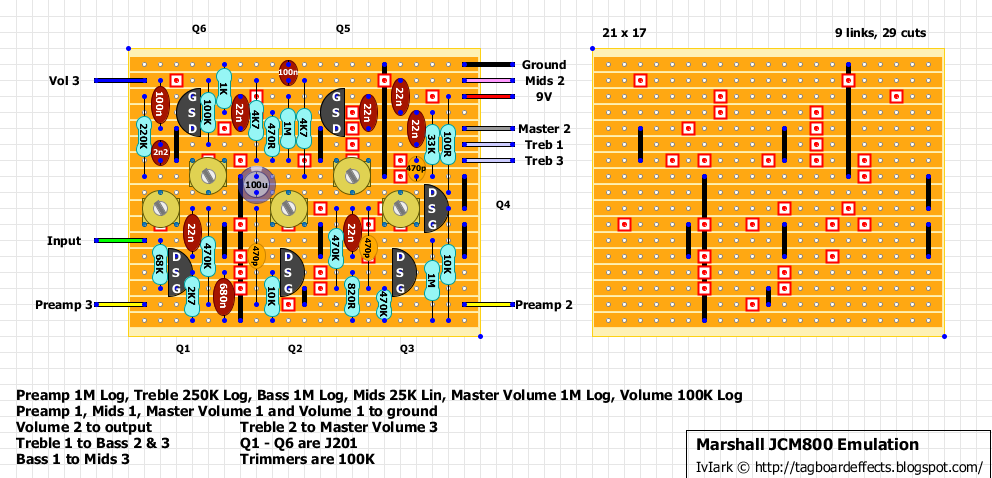
And another, being a classic rock guy this one appeals to me a lot! I can't find a lot of info about the source of the schematic, but looking at the JCM800 2204 scheme it is extremely close. As usual, use the trimmers to set the JFET drains (other than Q4) to between 4.5 and 5V.
I'm not sure if the pedal in this video uses the same schematic verbatim, but it should be very close if based on the JCM800 amp scheme and so should give a good idea of what to expect.
Emulation of the Soldano SLO 100 by GT Labs and including the suggested mods by Brymus. I've never really even used a presence control as they do nothing for me, and so I'd probably omit it altogether in this and the other recent amp emulations to reduce the number of pots, but I've left it in for those who want to include it.
I also included trimmers for Q1 to Q4 to allow you to bias each individually to around 4.5-5V. I just selected a trimmer that easily covered the drain resistor shown and so allow you to tweak significantly above and below the suggested resistor value. And again I included an axial cap because there was room for one that I have in stock, but a radial will do the job perfectly well if you don't have the axial.
I couldn't find any videos on this but a demo can be heard here.
And a layout based on the original scheme by GT Labs which John K thinks has a preferable drive control, and also including the original passive values with just a couple of tweaks:
and for those who would also prefer fixed resistors rather than trimmers this version uses the original drain resistor values, but I would suggest socketing as shown so you can fine tune the bias.