Showing posts with label Vox. Show all posts

Saturday, 20 January 2018

Jext Telez White Pedal

"A boutique pedal homage to the unique onboard overdrive circuit in vintage solid state Vox Conqueror amps that George Harrison used on the White Album and other Beatles recordings. The White Pedal has four knobs that control volume (overdrive), gain (fuzz), treble cut, and a bass cut knob that acts as a mid-boost, while a fifth knob (the Yoko knob) selects the midrange frequency to boost for a parked wah sound"

Original FSB thread and schematic available here.
Schematic should be correct but it's not verified yet


Monday, 1 January 2018

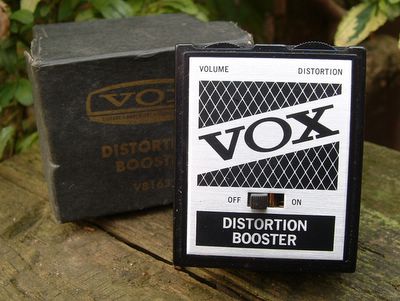
Vox Distortion Booster V2

Since I just poster the original Vox Distortion Booster, I figured I'd post the second version while i was at it. Just like the V8161 the V2 is also a  Fuzz Face variant. The Vox Distortion Booster V2 is similarly as rare as the V8161, but being a Fuzz Face variant I'm sure we all have an idea of how it will sound.


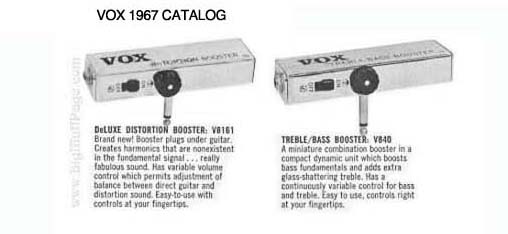
Vox Distortion Booster V8161

First layout of the new year!! Figured we'd start off right with another classic fuzz. The original Vox Distortion Booster is a Fuzz Face variant unlike the reissue, which there's a layout posted. The Vox Distortion Booster V8161 is stupid rare, so no video clips, but being a Fuzz Face variant I'm sure we all have an idea of how it will sound. The Distortion Booster V8161 was made to be plugged directly into your guitar, similar to other effects of the time period.


Thursday, 27 July 2017

VOX MKIV Tonebender

Description of the MKIV origin from the captain.
 
The origins. Tone Bender MKIII, Tone Bender MKIV. Same party different frock. Aside from the obvious differences in the enclosure type of these pedals any true solid definition of which is what in regards to circuit type is and will always be a little bit of an ambiguous subject. The way I always made sense of it in my head was in regards to the biasing. The early MKIII's were choppy, heavy, clumsy, a fuzzy lump hammer. The later MKIV's were smooth, dynamic, articulate, a distorted boxing glove. In between, you have a foggy transitional period. Even with the those definitions in place it never always runs true.


Friday, 10 March 2017

Vintage Wah Extravaganza

Well as promised I've taken the and made layouts for 7 of some of the most desirable vintage wahs. You'll notice that they all look damn near identical, and that's because they're all based on the same circuit with some component differences. So instead of doing my usual description for each, I figured I'll let the videos speak for themselves.

Original Thomas Organ CryBaby


Vox Grey Wah


Vox v847


Shin Ei Wah


Maestro Boomerang BG-1


Maestro Boomerang Wah BG-2

One note about the BG-2 that makes it different from all the others. The switch allows it to go from a wah to a volume pedal.


Colorsound Wah-Wah


Thursday, 2 March 2017

Italian Jen Wah Clyde McCoy

Had this sitting in my completed layout folder and completely forgot to post it. The legendary Italian Clyde McCoy Wah from 67-68. 


Thursday, 1 October 2015

Catalinbread Galileo MKII

Here is a layout for the Catalinbread Galileo MKII, the new, updated version of the well known Galileo.

Info about the original:
The Galileo is a custom-tuned Rangemaster booster combined with the pre-amp section of a Vox AC30 delivering the distinctive throaty mid-range and jangly crunch of Brian May.
The Galileo has three controls tuned to deliver the essence of the Brian May sound - GAIN, TONE, and VOLUME.
With guitar volume knob turned full up, you’ll get the soaring lead tones and tight but aggressive rhythm tones of Brian May.
Turn your guitar volume knob down slightly and you’ll be tying your mother down all night.
Turn your guitar down further and you’ll get an amazing jangly clean sound that isn’t really clean but is!
In a full band context, this pedal will cut through with just the right frequencies to fit perfectly in the mix.


Sunday, 13 July 2014

Vox V830 Distortion Booster

Yes. It is big. I've omitted the complex power supply, but left most of the noise reduction measures in tact. Transistor controlled LED circuitry is also gone. With dual gang gain pot and the board size, this will be a tricky but doable fit in 1590B.

Marketing spiel from ten years ago:
Attention: Guitarist who want the fattest distortion. 
Classic distortion, warm tone and high gain. The V830 delivers distortion that goes from 'just enough" to blistering. And its VOX, all analog circuit ensures that your guitar's sound is always warm and natural - no matter what level of distortion you dial in.

Versatile, to fit your style and the way you want to play.
Whether you're into low string riffs on an axe tuned down to D, or paint peeling high notes, the V830's unique design gives you great distortion without losing it's edge and becoming muddy. Even power chords never loose their harmony. The VOX Distortion Booster, for guitar with an attitude!

Three controls - that's all you need. 
The Distortion Booster's DRIVE, LEVEL and TONE knobs give you all the control you need to get the tone you want. It couldn't be any faster or easier to get the sound you need. And, VOX's true-bypass switching ensures that your direct sound is unaltered when you hit the footswitch and bypass the pedal's circuitry.


Saturday, 12 July 2014

Vox V810 Valve-Tone

Yup. Vox made TS. I omitted the overly complex  power supply section and transistor based LED operation. Input and output buffers are 2SC2389 in the original units. You could also use those instead of 2N5088/2N5089. Just mind the pinout. Schematic i have has the output pulldown resistor at 1K, which seems way too small for me. I left that at 100K, like we find in some other TS derivatives. You could, of course, try the 1K in that position. It could also work as the output cap in most Vox pedals is also ridiculous 100µ. The high pass filter the output cap and that resistor creates has roll off frequency of 0,1-1Hz, depending on the value between 1K and 100K, so i don't think that value will affect the sound at all. Either way. It's so lightly modified TS, that it may be more preferable unit to some when compared against the green classic.


Monday, 4 March 2013

Vox Tonebender compact version

I was doing a request, and this one was so close to the one requested, so i thought i'd draw it up too. Mark has published this in the past and that one fits easily in B, but the one i'm posting now should be doable even in A... :) This also features a trimmer for nailing the bias just right for your transistors.

It may sound a bit thin to someone's liking, so upping the 4n7 for 10n, 15n or maybe even 22n would give you much more bass responce.

First up, the PNP version (this uses positive ground, so a inverter circuit as a addon, perhaps?):


And the NPN (to be daisy chainable):

Wednesday, 16 January 2013

Vox/Guyatone Zoom Distortion Box

This design is pretty close to OD250/Dist+, but i thought it should be added anyway, as there are some slight differences. Funny thing is that the same circuit was marketed and sold as both Vox Distortion and Guyatone Zoom Distortion Box. From what i can tell from the demo, it's really nice sounding thing. These both also seem to be pretty rare items with hefty price tags - if you can find one.

In my experience with 250 and Dist+, the pots may give better control with linear instead of original log taper.