Showing posts sorted by relevance for query vox. Sort by date Show all posts

Sunday, 13 July 2014

Vox V830 Distortion Booster

Yes. It is big. I've omitted the complex power supply, but left most of the noise reduction measures in tact. Transistor controlled LED circuitry is also gone. With dual gang gain pot and the board size, this will be a tricky but doable fit in 1590B.

Marketing spiel from ten years ago:
Attention: Guitarist who want the fattest distortion. 
Classic distortion, warm tone and high gain. The V830 delivers distortion that goes from 'just enough" to blistering. And its VOX, all analog circuit ensures that your guitar's sound is always warm and natural - no matter what level of distortion you dial in.

Versatile, to fit your style and the way you want to play.
Whether you're into low string riffs on an axe tuned down to D, or paint peeling high notes, the V830's unique design gives you great distortion without losing it's edge and becoming muddy. Even power chords never loose their harmony. The VOX Distortion Booster, for guitar with an attitude!

Three controls - that's all you need. 
The Distortion Booster's DRIVE, LEVEL and TONE knobs give you all the control you need to get the tone you want. It couldn't be any faster or easier to get the sound you need. And, VOX's true-bypass switching ensures that your direct sound is unaltered when you hit the footswitch and bypass the pedal's circuitry.


Wednesday, 2 April 2014

Moosapotamus Skippy Tremolo / Ring Mod

Based on the Vox Repeat Percussion but with greater control options, and another advantage is this version uses the 2N6027 Programmable Unijunction Transistor which is still available cheaply and in quantity, so you don't have to search around for 2N2646's and pay top dollar for them. 

I haven't included the connections required for external expression pedal rate control, opting to keep it self contained, but if you do want to include one, make the connections to the control socket to where the rate pot currently connects to the board, as shown in the scheme on the Moosapotamus site.

Info from Moosapotamus about their pedal:

The SKIPPY tremolo is based on the vintage Vox Repeat Percussion. The original VRP is well known for it’s very hard, percussive tremolo sound, or chop. Certain combinations of speed settings and playing style can almost trick your ears into thinking that you are playing through a delay instead of a tremolo. For these reasons, the sound of this tremolo effect is often described as synth-like.

Originally, the VRP had only one control, Rate, to adjust the speed of the effect. In addition, the version that was built into the Vox Beatle Super Reverb amplifier also had an input jack for a foot pedal that enabled you to control the speed of the effect with your foot.

With additional controls and features, SKIPPY covers a much wider sonic range while still retaining all the character and bravado of the original VRP. Check out the video…

CONTROLS
Depth - Adjust effect depth from subtle throb to hard chop.
Rate - Adjust effect speed.
Level - Adjust output volume to compensate for perceived volume loss with certain extreme settings.
Tone - Switch original Vox low-cut filter on or off. When on, output has a lot of treble and very little bass.
Mode - Switch between hi and low speed ranges. Low speed is normal tremolo range. Hi speed is pseudo ring-modulator range.

FEATURES
Plug CV pedal into control jack to vary speed with foot while playing.
Capable of ultra-wide range of speeds, up to pseudo ring-modulator speeds.


Monday, 28 April 2014

Bearfoot Emerald Green Distortion Machine

Today is Bearfoot day.  Info about the original

For the Vox lover in all of us, Bearfoot FX has created the Emerald Green Distortion Machine- a pedal which captures the chimey, crunchy essence of the AC series amps and provides a faithful simulation of the Vox tone through a variety of amps. Used through a Vox, this pedal acts as a booster driver to really push your amp into sonic heaven.  The EGDM Distortion and Voice controls are interactive and used together will take you from the low, clean tones of an AC all the way up to the screaming tone of a cranked Vox. The EGDM is extremely responsive to picking dynamics and your guitar’s volume knob.  

Bearfoot FX is the brainchild of Bjorn Juhl of BJF Design and Donner Rusk of Donnerbox. Every pedal is handpainted and no two are exactly alike. The pedals now ship with a plain, unpainted bottom plate to help ensure the most secure contact with adhesive Velcro for use on pedalboards. Bearfoot FX pedals are handmade in St. Louis, Missouri, USA. 


BUY A KIT

Sunday, 27 May 2012

Hipkitty Oxblood Distortion

Information from the builder:

The Oxblood Distortion was designed to emulate the tone and response of an old Vox AC15 with added gain at the input stage. Unlike other Vox-like pedals which emulate the tone and response of the Vox AC30, only the Oxblood Distortion emulates a boosted AC15.

Unique to the Oxblood Distortion is it's ability to make a "large" amp sound "small" and in hyper-drive with the tone of the AC15.

Also unique to the Oxblood Distortion is it's controlled output. While other distortion pedals use greater than unity gain at output to alter the user's amplifier input stages, the Oxblood Distortion does not. This keeps the true tone and response of the effect intact throughout the initial preamp stage of the amplifier in use.


The schematic by WhiteKeyHole that I did this from (big thanks to him as usual for his great tracing) didn't include a supply filter cap, and so I did the layout above exactly as per the schematic.  If you want to include one then you can use the following layout.  I've used an axial cap because I have those to hand in that size, but you could use a radial cap if that's what you have available, and you could probably reduce the layout in width by a column if you do.


A couple of notes based on the FSB thread, if you want more volume then you could reduce the value of the 10K resistor at Q3 collector, for more bite reduce the 220n in the middle between row 1 and 4.  Maybe socket and experiment to fine tune it to your liking.

Sunday, 19 May 2013

Runoffgroove Matchbox

Here's one more from the ROG archives. Apparently amazing sounding OD/dist. Should be doable in 1590B, if you feel brave enough with the rotary :)


From ROG: Back in the mid-90s, the Matchless DC/30 became one of the first boutique amps to hit the market. It excelled at clean tones, as well as thick Vox-like overdriven lead sounds.
There is good reason for the similarity in sound to a Vox amp. The lead channel of the DC/30 appears to be a modified Vox AC30/4. The AC30/4 amp featured the EF86 pentode preamp tube, just as the Matchless design.
runoffgroove.com set out to capture the lead sound of the Matchless DC/30 amp, using the technique developed by Doug Hammond for his excellent Meteor circuit.
We opted for a MOSFET to replace the EF86 tube. The MOSFET has better gain and fidelity attributes than the JFETs we normally use. We used J201 JFETs for the remaining two stages.
We've named this circuit the Matchbox.
An item of interest in this circuit is the odd-looking Tone control. This is in some ways similar to the FAC control on old Orange amplifiers. The sound is "thinnest" on setting A, and gets thicker as you progress through the settings. The Cut control acts as a simple Low Pass Filter. As you turn it counter clockwise, it will roll off some of the treble frequencies. We departed from the schematic a bit here. We used a 10n cap where the amp used only a 2n2. The reason for our deviation is to achieve a more dramatic effect.
NOTES:
-Try using a different MOSFET for the first stage. A 2N7000 sounded a bit "tighter" than a BS170. BS170 had a nice "loose" sound. 
-Any N-channel MOSFET can be used, but as always, pay close attention to the pinout. 
-Try to use all metal film caps in this circuit. It really seems to add to the smoothness of the sound. Ceramic caps or "greenies" will work fine, but you will probably notice a bit more "grainy" sound. 
-A 12v Zener diode can be used in place of the LED used for static protection of the MOSFET. 
-Philip Miller Tate (a.k.a. Ge_Whiz) found the Cut control to be quite subtle when using the stock values. He reports that substituting a 47nF capacitor and 50k-B pot provided a much more effective control. 
-You can use other JFETs, but be warned! The middle stage may not bias correctly or have enough gain to distort. Try other transistors at your own risk. PLEASE do not post on Aron's Stompbox Forum with a complaint about the circuit does not working or sounding good when you do not use the specified components. You can always purchase J201 FETs from our friend, Steve Daniels at www.smallbearelec.com, who will ship to anywhere in the world.


Monday, 1 January 2018

Vox Distortion Booster V2

Since I just poster the original Vox Distortion Booster, I figured I'd post the second version while i was at it. Just like the V8161 the V2 is also a  Fuzz Face variant. The Vox Distortion Booster V2 is similarly as rare as the V8161, but being a Fuzz Face variant I'm sure we all have an idea of how it will sound.


Saturday, 12 July 2014

Vox V810 Valve-Tone

Yup. Vox made TS. I omitted the overly complex  power supply section and transistor based LED operation. Input and output buffers are 2SC2389 in the original units. You could also use those instead of 2N5088/2N5089. Just mind the pinout. Schematic i have has the output pulldown resistor at 1K, which seems way too small for me. I left that at 100K, like we find in some other TS derivatives. You could, of course, try the 1K in that position. It could also work as the output cap in most Vox pedals is also ridiculous 100µ. The high pass filter the output cap and that resistor creates has roll off frequency of 0,1-1Hz, depending on the value between 1K and 100K, so i don't think that value will affect the sound at all. Either way. It's so lightly modified TS, that it may be more preferable unit to some when compared against the green classic.


Saturday, 22 December 2012

Runoffgroove Tonemender

From ROG:The Tonemender is a very flexible, yet simple clean boost with a 3-knob tonestack that allows the user to re-create the classic Fender, Marshall and Vox responses.

We suggest using a TLC2272 for the dual op-amp. The TLC2272 is rated for low-noise and rail-to-rail output, which will offer the highest possible clean boost and dynamic range. The NE5532 is another good choice, but a TL072 can also be used with decent results.

The Mid Shift switch (SW1 on the schematic) selects the center frequency of the midrange dip in the response. The center frequency is moved from around 700Hz (Marshall/Vox) down to 400Hz (Fender) in the HI and LO settings, respectively.

For Fender-style curves, the Mid Shift is placed in the LO setting (closed). To replicate Marshall-style curves, switch the Mid Shift to the HI position (open). Set the Mid control between 12:00 and 5:00 for traditional Marshall settings, with lower settings providing additional flexibility. For a Vox-style response, keep the Mid Shift in the HI setting and set the Mids control fixed at 10:00 and move the Bass between 7:00 and 12:00.

A "flat" equalizer position is set with the Bass and Treble both at minimum, and the Mid control at its midpoint. When Bass and Treble are fully cut, the Mid knob acts as an additional Level control, which is a familiar characteristic of the Fender tonestack.


I've thrown out the previous version as this one is simply better. And definitely verified. There's quite a lot of gain coming from the circuit, so some squeels and noise from the unboxed circuits are expected.


Geiri's demo of his awesome Double Tonemender!


Tuesday, 22 January 2013

Briggs' 64 Vintage

As requested. From Mr. Briggs:
Here's another (nearly) new one from me. It's a tricked out super mod of the old Electro Harmonix LPB-1 circuit that produces some lovely singing overdrive tones reminiscent of an old VOX from their 1960's heyday. I took the Lovepedal Englishman (A supposed Vox AC30 / AC15 emulator) as a base and went from there - Firstly I wanted a little more gain, hence the 4k7 collector resistor. Along with more gain I wanted more emphasis and clipping on the higher mids to replicate that treble laden Vox overdrive hence the 82nF bypass cap and the 47k/22nF mids filter at the end of the circuit. These changes make the circuit sound livelier and give it more character. The use of the *super* low forward voltage SB340 diode in combo with the BAT46 diode produces harmonically rick asymmetrical clipping, the levels of which can be controlled using the "Headroom" control. The headroom control also allows a nice rich low end to be retained while allowing the top end to be clipped, as you roll back the clipping a nice tube like "note attack sag" effect becomes prominent - it's quite pleasing and cool to play with. The use of the 2N3565 transistor is due to some tests carried out a while ago where it was found that the 2N3565 sounded best in these sort of applications, you can replace it with a 2N5088 or BC108 or, in fact, any decent gain NPN transistor.


Friday, 6 July 2012

ROG English Channel

Info from the Runoffgroove website:

The Vox AC-30 amp is considered by many to be the defining sound of the British Invasion during the 1960s. The Top Boost circuitry provided crisp treble-laden overdrive that perfectly complemented the rich bass content. The English Channel is a JFET-based distortion stompbox that uses the same basic architecture as that classic early '60s amp.

This circuit is based on a 1961 Vox AC-30 with Top Boost, as designed by Tom Jennings and Dick Denney. Artists such as Tom Petty, Brian May, the Rolling Stones, the Beatles and the Shadows have used the AC-30 during their careers.

The above schematic replicates the Brilliant input, but the Normal input can be simulated by changing the 470pF cap to 47nF.
(A DPDT switch to select either 470p or 47n sounds like a good idea to me for a possible mod - Mark)

To obtain 1.6v at the source of Q4, you may need to try different J201 or adjust the 4k7 resistor. During testing and development, values as high as 12k were necessary for some J201. Try to get close to 1.6v, but slightly lower values will have no audible difference.

Note that the Cut control is set up in the traditional manner, reducing treble as turned clockwise.

Philip Miller Tate (a.k.a. Ge_Whiz) found the Cut control to be quite subtle when using the stock values. He reports that substituting a 47nF capacitor and 50k-B pot provided a much more effective control.


I, mirosol, added the following: I just recently built one of these again, and noticed that couple small things could make it even better. Not that there's anything wrong with it as it is, but - i used 50K trimmers for more accurate biasing of the JFETs, linear pot for Treble, swapped the Cut pot lugs and made it 50K with 47n cap, bigger Master pot for sligtly more overall volume and the switch for Brilliant/Normal channels. The 470p felt way too thin, so 1n/47n combo on a switch sounded perfect. I also moved things slightly around to get the switch in neatly, plus i added the polarity protection diode.. Here you go. My slight mods for this, very, very nice sounding Vox in a Box.


Monday, 1 January 2018

Vox Distortion Booster V8161

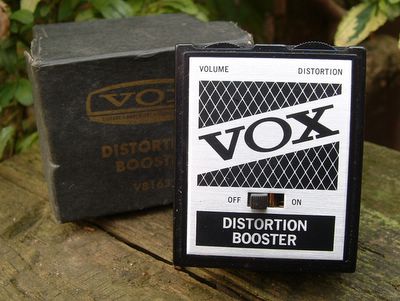
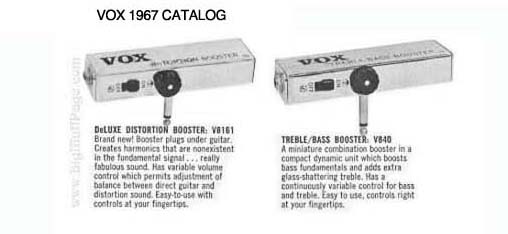
First layout of the new year!! Figured we'd start off right with another classic fuzz. The original Vox Distortion Booster is a Fuzz Face variant unlike the reissue, which there's a layout posted. The Vox Distortion Booster V8161 is stupid rare, so no video clips, but being a Fuzz Face variant I'm sure we all have an idea of how it will sound. The Distortion Booster V8161 was made to be plugged directly into your guitar, similar to other effects of the time period.


Wednesday, 16 January 2013

Vox/Guyatone Zoom Distortion Box

This design is pretty close to OD250/Dist+, but i thought it should be added anyway, as there are some slight differences. Funny thing is that the same circuit was marketed and sold as both Vox Distortion and Guyatone Zoom Distortion Box. From what i can tell from the demo, it's really nice sounding thing. These both also seem to be pretty rare items with hefty price tags - if you can find one.

In my experience with 250 and Dist+, the pots may give better control with linear instead of original log taper.


Monday, 29 April 2013

EarthQuaker Devices Hummingbird

It's a modded Vox Repeat Percussion so more use for those 2N2646's you stocked up on.

Info about the original:

The Hummingbird is, at heart, a hard and choppy tremolo. What comes out is more akin to vintage synth style oscillations. It's core is based on the old Vox Repeat Percussion with several updates to reduce noise, enhance the "chop" and add more control. It can create ring mod-like octaves, slow pulses, ping pong delay-like stutters, light blipping through machine gun stutter tremolo and many more wacky sounds!

Controls:
Depth- Controls amount of modulation from barely there to full signal chop.
Rate- Controls the speed of the LFO
Level- controls the input/output level
Mode- fast/slow switch for LFO rate


Sunday, 26 August 2012

DAM FR70 FuzzRong

Info from David Main about his original:

We begin with a re-cap. The FR-69, our take on the early bird Mosrite Fuzzrite. The germanium powered glass shattering freak show. As stated on the page for said pedal my only real interest there was because of the awesomeness of Ron Asheton and the Stooges. In other words, there is no real nerd obsession with the pedal itself. Thanks to a trip to London a visit to a Soho's Original Bookshop and the discovery of Robert Matheu's outstanding book on the Stooges I think it maybe wise to dispel the "Ron used a Fuzzrite" myth once and for all, that is until someone shows me a picture of Ron actually using one.
Robert's fine book has several fine shots that clearly show Ron actually using a Vox Tone Bender. Other photographic material that can be sourced on the internets show Ron with what appears to be a Marshall Supa Fuzz. Either way, it ain't no Fuzzrite. In a nutshell and in my head at least. Dig the early Stooges fuzz tone? Get high, get a Vox. Simple.

So what has this gotta do with the FR-70? Not a damn thing. Just explaining what we ain't doing here. So this new Fuzzrong is...? Outta the whole Ed Sanner family of pedals and the different versions produced the one I always had a genuine soft spot for were those made with the freaky little orange encapsulated Sprague circuits. Louder, chewier and with mightier balls. I've always been fond of the general sickly thickness and the almost psychedelic nature they seem to have. This is basically our salute to the those funky little orange packages of filthy fun.

Operation scratch 'n' sniff

Like with all good workings it began with a sacrifice. An offering to the Fuzz God. The pre-selected healthy young virgin was carefully dissected to reveal the inner workings and the bounteous gifts of the unknown. With much suffering and toil the knowledge of the highest degree was gained. Our dissected orange goddess became the starting block for what you see here. The FR-70 is not a direct clone but and very gentle tuck and re-shape. It's difficult to generalize too much as the Sprague modules were not or at least don't appear to be 100% identical tonally when in use. Like with any discrete fuzz circuit you will always have some play or movement in the delivered fuzz tone. The sacrificial lamb was an example I found particularly pleasing. The gentle refinements then move it into a somewhat more balanced state that aid reproduction for a more modern parts selection.
Constructed like her greasy twin sister the FR-70 uses the same methods of assembly and the same principles of design as the GB-83. Specially selected silicon devices are the foundation to the whole circuit. Very precise gain levels had to be matched and then reproduction to achieve the desired balance in tone. The same detail is then applied to the whole pedal. Basically every component and part is selected for overall sound quality and performance.

Psychedelic goose fat

So the tones from within the tin. The first thing to note compared to the FR-69 is that the overall operation is more stable. The gain spread on the Depth control is much more even with a greater extension of the mid and low frequencies. The general position that the FR-70 takes is an offering of tones that are situated in the low mids with a punched out boost over into the highs. It's not quite scooped as such but a subtle high and low kick is dB boost is apparent. The gain and sustain levels are also more stable and maybe more user friendly. For example, the FR-70 is not a screamer from the get-go. Again something shared with the GB-83 is that you have to put the work in and use the right gear to get to your destination. The FR-70 does have the where with all to get fatty and rancid with some pleasing fuzzed-out compression but the subtleties are also an important factor in my head so the ability to draw pretty flowers with trails of magic dust is there for the taking too. I guess like the GB-83 it is somewhat tool like. It is a fuzz generator but you have to give it the instructions. Not quite a blank canvas as such but fully able to work with and around you. It's sick & rong but only as much as you are, my dears.


Compact layout:


Mojo layout:


Friday, 10 March 2017

Vintage Wah Extravaganza

Well as promised I've taken the and made layouts for 7 of some of the most desirable vintage wahs. You'll notice that they all look damn near identical, and that's because they're all based on the same circuit with some component differences. So instead of doing my usual description for each, I figured I'll let the videos speak for themselves.

Original Thomas Organ CryBaby


Vox Grey Wah


Vox v847


Shin Ei Wah


Maestro Boomerang BG-1


Maestro Boomerang Wah BG-2

One note about the BG-2 that makes it different from all the others. The switch allows it to go from a wah to a volume pedal.


Colorsound Wah-Wah


Friday, 29 September 2017

Lumpy's Tone Shop Lemon Drop/ZII/Series 7

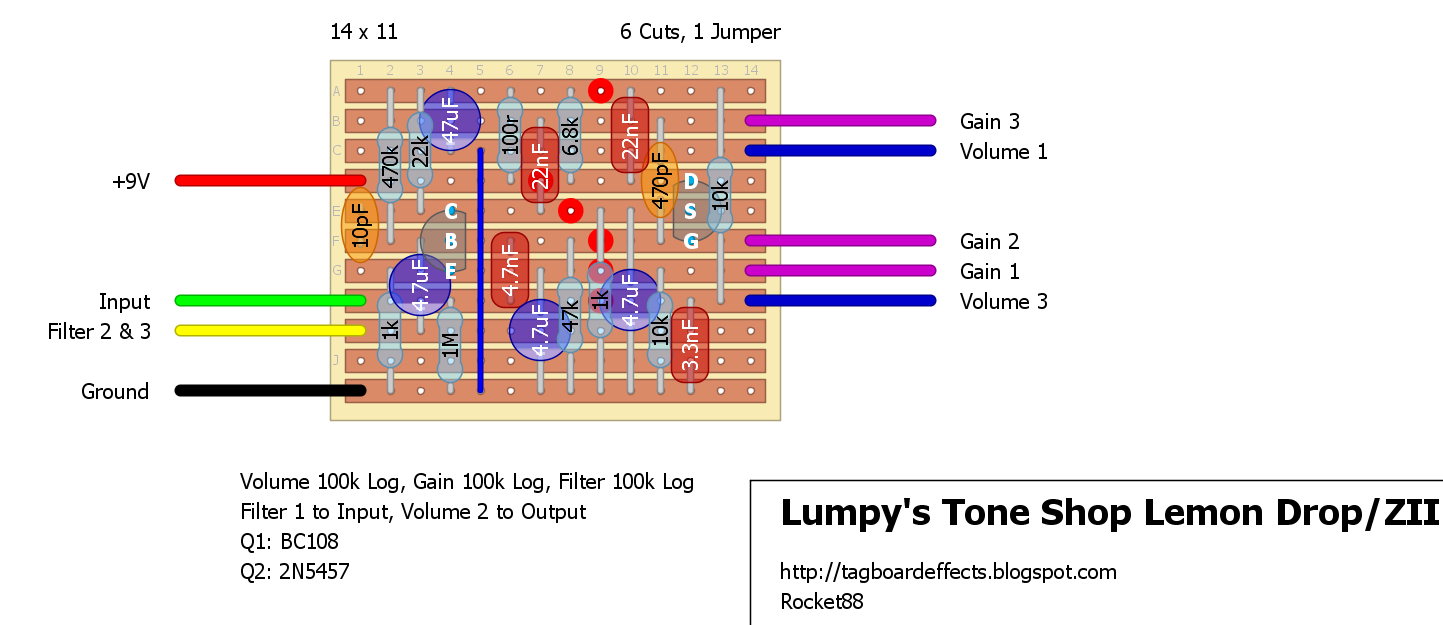
Originally sold as the Lemon Drop, then the ZII, and now the Series 7.

Description of the Series 7 from the source:

Designed to mimic the unique overdriven tones of the rare Vox 4&7 series amplifiers in a small and easy to use stompbox.  An unknown amp to most, the 4&7 series amps were most famously used by the Beatles during the Revolver era and Jimmy Page on numerous tracks from the second Zep album.  Think Paperback Writer style of tones and, yes, Whole Lotta Love.

The 7 Series Overdrive captures the aggressive qualities of the solid state preamp found in the 4&7 series amps by using a pseudo hybrid setup consisting of a specifically selected silicon transistor for the first stage which adds a distinct bite and growl.  That pushes an FET stage into clipping adding some warmth, sustain and amp like dynamics to the tone and feel.  The end result is a highly effective emulation of the amp and a unique sonic blend that could be characterized as a "fuzzy overdrive."


As it's been pointed out there are some pictures with the 2.2uF coming off the emitter to ground as 4.7uF. I've seen pictures with 2.2uF as well, so I'm under the assumption that there's multiple versions as the pedal has changed names over the years. I changed the value of the cap so now there's 2 different layouts. With the 4.7uF cap the pedal should fatten up more compared to the 2.2uF. 


Thursday, 19 September 2013

BJFE / Bearfoot Model G

I was struggling to get this one 21 columns wide max, so Miro will have to forgive me for the placing the Nature pot wires at different sides of the board.  Sorry mate :o)

Info about the original:

The Model G captures the unique voice and response of an often overlooked brand of amps from the 50s/60s ~ the Gibsons that were right there at the beginning with Fender, Valco ,Vox and Marshall..

Somewhere near the tweeds and supros but with a stronger and clearer voice, and a particular upper mid sound and snarl.

The Model G is related to the Honey Bee the same way a Gibson Falcon or GA40 is related to a Supro … cousins with obvious similarities, but important differences.

The volume, drive and nature controls are on both models.

The C knob is a big part of the difference – it controls several things at once:  the upper mids eq and snarl and  slight speaker compression … like adjusting to different speaker choices and ages or even like moving a mic aimed at the speaker.


Wednesday, 3 October 2012

Catalinbread Galileo

Info from ProGuitarShop about Catalinbread's original:

In January of 2012 I began speaking with Nicholas from Catalinbread about making us a dual overdrive pedal. I didn't have anything specific in mind. I wanted to begin the discussion of putting two of his drive pedals in one box. After a couple of meetings and many cocktails we agreed that it would make a great deal of sense to put the CB30 and Naga Viper together in one box and go after a cranked AC30 with a treble booster sound. A sound made famous by many Vox users of the 60's.  We then began to think a bit more of a specific sound that we were looking for and the Galileo was born. Scaramouche! Scaramouche! Will you do the Fandango?!

Magnifico! Plug into the new Catalinbread Galileo and your brain may see stars. Catalinbread has created a hotter upgrade to their already phenomenal CB30, added a dedicated, fine tuned treble boost, courtesy of their Naga Viper circuitry, and housed it all in a single majestic gold pedal decorated with the well-earned insignia of rock and roll royalty. The Galileo delivers the regal, operatic sound you would expect from a wall of AC30s with all of the controls you need to rule your own creative realm. In addition to controls for Volume, Bass and Treble, the Gain control gives you a broad sweep of that singularly expressive overdrive while the Top Boost control lets you dial in all of the high end definition that will take your breath away. Two footswitches give you the flexibility to operate without the high-end augmentation, or opt for true bypass of the whole pedal.


Update: Oscar Jr below let me know the circuits are independently switched which makes the description bizarre.  They are both apparently independent and the Naga is first in the chain from the input socket. 

Update 2: It has been suggested that the 100K resistor at the bottom right near Q3 should be replaced by a 51K which inproves the sound.  It may be worth experimenting here to see which you prefer.


Passive Bill of Materials:

Group          Name    Qty
Capacitors     100n     1
Capacitors     100p     1
Capacitors     10n      1
Capacitors     1n       1
Capacitors     220n     1
Capacitors     22n      1
Capacitors     22u      1
Capacitors     2u2      1
Capacitors     330p     1
Capacitors     470p     1
Capacitors     47p      1
Capacitors     47u      1
Capacitors     4n7      1
Resistors      100K     1
Resistors      12K      1
Resistors      1M       1
Resistors      220K     1
Resistors      2M2      1
Resistors      390R     1
Resistors      470K     1
Resistors      470R     1
Resistors      47K      1
Resistors      4K7      1
Resistors      56K      1
Resistors      68K      1
Resistors      8K2      1


Saturday, 8 February 2014

Monolith Fuzz Oracle

This is a nice aggressive sounding fuzz.  The switch on the original is a push pull on the Color pot and so you can either do the same and get a 250K switched pot, or alternatively just use a DPDT 2 position toggle.

Info from Monolith Fuzz about the original:

The Oracle Fuzz is my original twist on the fuzztone "in my head"... Imagine an Italian made Vox Tonebender (2 transistor MK 1.5 circuit) with all of it's lovely midrange-heavy goodness mixed with the throaty low "huumphh" of an early Big Muff, and you're getting warm. 


Saturday, 29 September 2012

Vox Tone Bender

Found a couple of old ones that by the looks of them I did ages ago, but haven't posted yet.  May as well get them on here to keep everything together. :o)  I haven't mentioned which transistors but they're germanium so just use your favourites.

This video was apparently narrated by Stephen Hawking


PNP Version


NPN Version