We've been posting tagboard and vero layouts for 5 years now and with myself and Miro being quiet for a while people have expressed some concern about where the site is going. We have no intention of giving up on DIY but sometimes personal commitments take over and talking from a personal perspective a combination of a trapped nerve, a death in the family and a new job have taken a lot out of me. It was impossible to concentrate like I needed to when I had the trapped nerve and by the time that had cleared up to the point I could, other things came up one after another to the point when the little bit of free time I got I just wanted to relax rather than spend hours squinting at schematics.
But we have built a great community here, something that is emphasised by a quick scan in the forum where some excellent topics are discussed and new circuits developed, with a continually enthusiastic audience. So I think the site deserves a shot in the arm and something to get it moving again, maybe in different directions.
As such myself and Miro have spoken before about having more administrators and authors on the blog and it is with pleasure that we can now introduce Javi (JaviCAP), Zach (rocket88), Travis (Travis) :o), and Alex80 (Alex) as new administrators and authors. All have been active members for a long time now and have helped make the blog and especially the forum a great place to be.
This isn't necessarily to just add new layouts to the blog because there really isn't as many to go at now we've posted over 800 layouts, but also potentially to move in other directions to appeal to a wider audience. So posts about general DIY, tips and tricks, and other things that will be of interest to people can help liven the place up and give people some interesting opinions to read. There can also never be too many people to answer questions! :o)
So we have increased the numbers by 4 at this stage, but there are a number of other people on the blog and forum who have been great members of the site and contributed massively, and to be honest I am happy to increase the admin numbers more if some other people think they have something they would like to contribute. Be that vero, perf or maybe PCB layouts. General DIY posts? Or what about amps? I'm happy for us to go in whatever direction the members here want, and I'm always available on email if anyone wants a chat about it.
At the end of the day I want us to provide something for everyone interested in DIY am sure that the guys we have asked will help us do that.
Solder on dudes! :o)
Thursday, 27 August 2015


Saturday, 21 March 2015
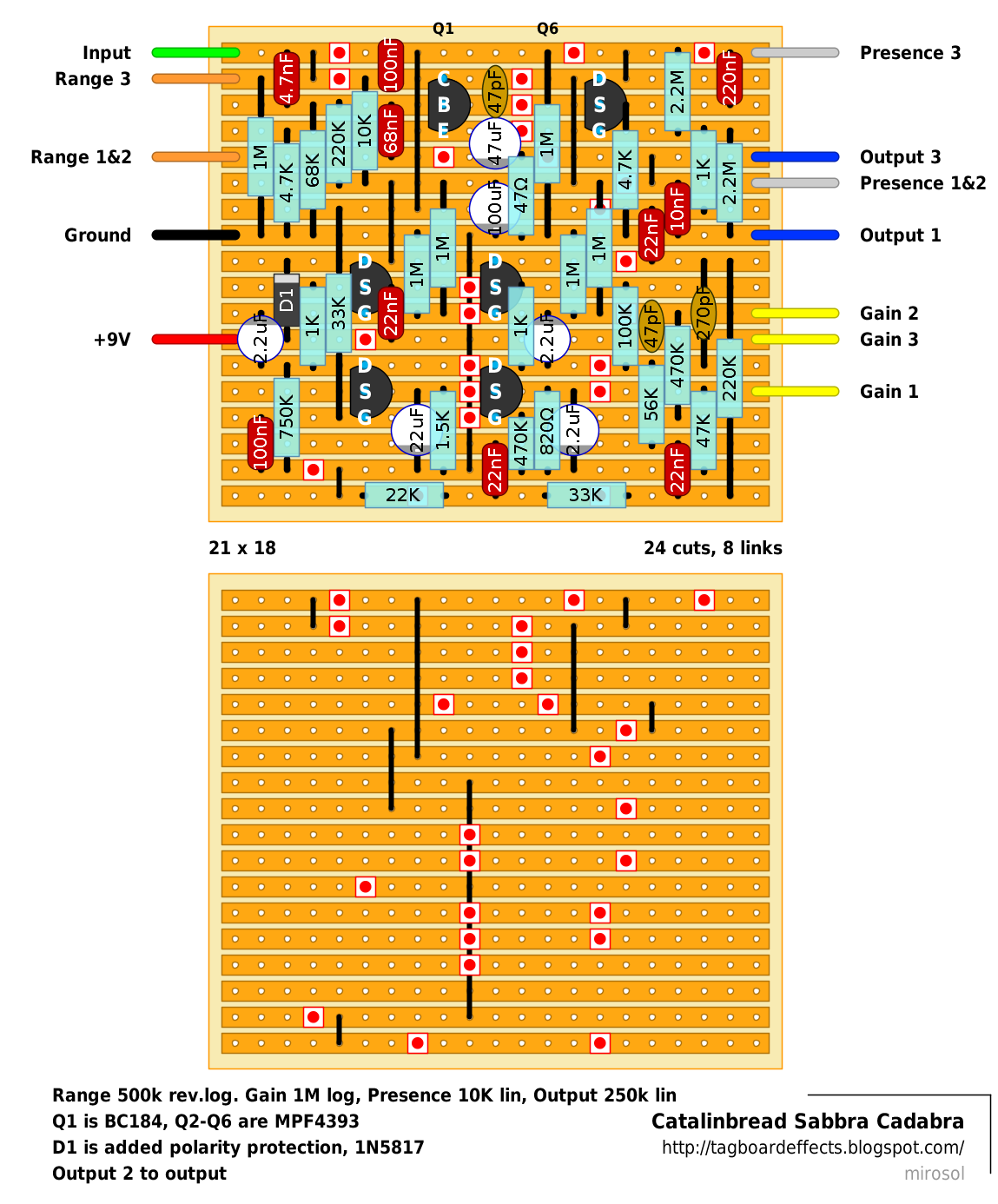
Catalinbread Sabbra Cadabra
Update, 22.3.2015 **There were couple minor issues with the schematic. Both fixed for this version of the layout.**
Monday, 12 January 2015
MXR Distortion III
Being so similar to Wylde Signature and GT-OD, i can understand why this one was still missing from the library. Well. Up the 100n to 220n-1µ from inverting input of the driver amp to VRef and swap the clippers for LEDs. Should be worth your while...

HPF Technology HPF-Pre 2
I've had a few folks asking for active bass cutter circuit for couple of different uses. First, a lot of stoner rock enthusiast want to split their signal for two amps and some blues folks want to do that too. And since in cases like these, the second amp is usually a guitar amp, which will perform in a happier manner if we don't feed them the lowest frequencies. I got tipped off with HPF Technology's HPF-Pre 2. Even though the main aim for the design is to address issues with double basses, the circuit will work great on other applications as well. This design is open and for mainly that reason, i strongly recommend getting an original unit if you find use for this circuit. The price is more than just right, so your savings won't be much by building one. So. If you can, please support the orginal design.
I built one already to see if the board works with J201s and 2N3906. It does. The frequency pot should definitely be dual gang logarithmic taper.
A quick overview from the author:
HPF-Pre is a preamp with adjustable high pass filter and phase switch for use with piezoelectric pickups on the double bass. It is intended to address the primary issues faced by bassists when playing through mainstream amps and PA systems. Foremost, HPF-Pre is a preamp. Its high input impedance ensures proper buffering of the signal from piezo pickups. It is battery powered and housed in a tough plastic enclosure with internal shielding. An adjustable high pass filter tunes out the subharmonic “thump” generated by the plucked bass, which otherwise can drive ported bass speakers to over-excursion. It is also a useful tool for coping with adverse acoustical environments and PA systems with excessive subwoofer support. A phase (polarity reversal) switch is provided to help control feedback problems. It could also help when setting up systems with multiple pickups, or a pickup and a microphone. Series 2 of the preamp adds an output volume control and an LED battery status indicator. The volume control is handy when your stage setup requires your amp to be out of arm's reach. HPF-Pre is an "open" design. I sell the HPF-Pre at a modest price from my part-time home business. Otherwise, you are welcome to build your own.
Check the site and get the original from https://sites.google.com/site/hpftechllc/home

I built one already to see if the board works with J201s and 2N3906. It does. The frequency pot should definitely be dual gang logarithmic taper.
A quick overview from the author:
HPF-Pre is a preamp with adjustable high pass filter and phase switch for use with piezoelectric pickups on the double bass. It is intended to address the primary issues faced by bassists when playing through mainstream amps and PA systems. Foremost, HPF-Pre is a preamp. Its high input impedance ensures proper buffering of the signal from piezo pickups. It is battery powered and housed in a tough plastic enclosure with internal shielding. An adjustable high pass filter tunes out the subharmonic “thump” generated by the plucked bass, which otherwise can drive ported bass speakers to over-excursion. It is also a useful tool for coping with adverse acoustical environments and PA systems with excessive subwoofer support. A phase (polarity reversal) switch is provided to help control feedback problems. It could also help when setting up systems with multiple pickups, or a pickup and a microphone. Series 2 of the preamp adds an output volume control and an LED battery status indicator. The volume control is handy when your stage setup requires your amp to be out of arm's reach. HPF-Pre is an "open" design. I sell the HPF-Pre at a modest price from my part-time home business. Otherwise, you are welcome to build your own.
Check the site and get the original from https://sites.google.com/site/hpftechllc/home
Tuesday, 9 December 2014
Rockett WTF
7 weeks I've had a bloody trapped nerve in my back now, but I thought I'd better at least attempt to concentrate enough to do a layout every so often so you don't get bored.
The B%st pot is just a second volume control with the B%st stomp selecting between the two. I have shown the B%st LED connections for the switch, and to complete it you will need to connect the anode to 9V via a limiting resistor to taste.
Info about the original:
The WTF Fuzz is the fuzz for people who don’t like fuzz! Get mild OD sounds all the way to crazy random octave fuzz. You can achieve sounds similar to a trumpet or trombone as made famous by Paul Trombetta, who created this circuit for us….Thanks Paul!!
Thanks to Matt for the schematic for this Bosstone based effect.


and a modded version following suggestions from Paul Trombetta


The B%st pot is just a second volume control with the B%st stomp selecting between the two. I have shown the B%st LED connections for the switch, and to complete it you will need to connect the anode to 9V via a limiting resistor to taste.
Info about the original:
The WTF Fuzz is the fuzz for people who don’t like fuzz! Get mild OD sounds all the way to crazy random octave fuzz. You can achieve sounds similar to a trumpet or trombone as made famous by Paul Trombetta, who created this circuit for us….Thanks Paul!!
Thanks to Matt for the schematic for this Bosstone based effect.
and a modded version following suggestions from Paul Trombetta
Subscribe to:
Posts (Atom)