Here's a collection of vero (stripboard) and tagboard guitar and bass effect layouts that we have put together covering many classic and popular effects in growing numbers. Many of these have been posted on freestompboxes.org, so check that site out for great discussions on building your own effect pedals. Enjoy the builds and please also visit us on Facebook and Twitter
Although this isn't your usual muff clone, you can certainly tell where the inspiration came from. This pre-dates the EQD Hoof, but like that pedal this uses NPN germanium transistors for Q2 and Q3 but with schottky diodes here instead of LEDs. I can't find any information at all about the FS25444 838 Q4 transistor, but it is definitely NPN bipolar, and looking at a gut shot on the Frantone web site it's an old style TO106 style case like the 2N5133 that are much sought after for Big Muffs, or the ME4003 that I know a few people on here use. Anyway just try anything for that and let us know your results.
Info about the great sounding original:
Truly insane fuzztone! Over the top in every way using the classic tone of germanium transistors. This is the longest sustaining and smoothest sounding all-transistor fuzztone you will ever own. I have designed many fuzztones, including the 2000 New York City Big Muff for Electro-Harmonix, so believe me when I say that this is the most extreme one I have ever made. It's tone is indescribable. The full bottom and crisp highs will astound you, and the endless sustain will make you cry like a baby. But don't take my word for it.. try one for yourself!
All new Frantone effects come with full signal bypass and status light!
Each one of The Sweet fuzztones is hand-made in the USA by Frantone and features:
Tough cast aluminum case Black Epoxy Enamel finish True bypass switching Green indicator LED Steel LED bezel Switchcraft jacks Custom White Bakelite knobs Hard mounted PCB External power jack All teflon hook-up wire Really cute clear feet
Based on the Vox Repeat Percussion but with greater control options, and another advantage is this version uses the 2N6027 Programmable Unijunction Transistor which is still available cheaply and in quantity, so you don't have to search around for 2N2646's and pay top dollar for them.
I haven't included the connections required for external expression pedal rate control, opting to keep it self contained, but if you do want to include one, make the connections to the control socket to where the rate pot currently connects to the board, as shown in the scheme on the Moosapotamus site.
Info from Moosapotamus about their pedal:
The SKIPPY tremolo is based on the vintage Vox Repeat Percussion. The original VRP is well known for it’s very hard, percussive tremolo sound, or chop. Certain combinations of speed settings and playing style can almost trick your ears into thinking that you are playing through a delay instead of a tremolo. For these reasons, the sound of this tremolo effect is often described as synth-like.
Originally, the VRP had only one control, Rate, to adjust the speed of the effect. In addition, the version that was built into the Vox Beatle Super Reverb amplifier also had an input jack for a foot pedal that enabled you to control the speed of the effect with your foot.
With additional controls and features, SKIPPY covers a much wider sonic range while still retaining all the character and bravado of the original VRP. Check out the video…
CONTROLS Depth - Adjust effect depth from subtle throb to hard chop. Rate - Adjust effect speed. Level - Adjust output volume to compensate for perceived volume loss with certain extreme settings. Tone - Switch original Vox low-cut filter on or off. When on, output has a lot of treble and very little bass. Mode - Switch between hi and low speed ranges. Low speed is normal tremolo range. Hi speed is pseudo ring-modulator range.
FEATURES Plug CV pedal into control jack to vary speed with foot while playing. Capable of ultra-wide range of speeds, up to pseudo ring-modulator speeds.
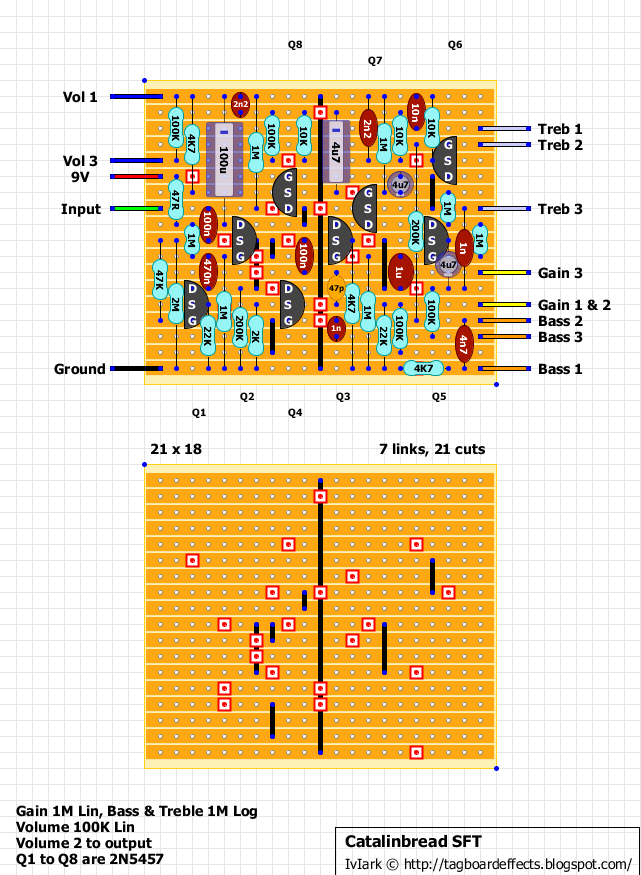
One of the layouts that is frequently mentioned so I thought I'd do a tagboardeffects version of it. There's a couple of axial electrolytics in there, simply because I have them in that size and to me they suit the layout as it is better than radial, but as usual, use whatever you have.
Info about the original: When we originally set out on our quest to make the best Bass overdrive ever, we never imagined that it could also sound so amazing with guitar – but then we got to thinking about some of the classic late ‘60s/early ‘70s ‘Ya-Yas’ era tones and thought we should take a stab at them. And heck while we’re at it, it would be really cool if it worked for the more modern drop tuned heavy stuff too. Made sense since those tones were due in large part to guitars being played through amps designed for bass, right?
And what about the Bass tones? We wanted a pedal that FINALLY let you control the amount of grind solely based on your finger attack. You know the feeling - full and rich and clean when you brush lightly and some nice wooly edge when you dig in. At the other end of the sonic spectrum we wanted a drive pedal that could deliver bone-crunching grind and still hold together without sounding thin or turning into a sludgy mess no matter how hard you hit it.
So we did a LOT of listening – listening for the dynamics, how the pedal responds to pick or finger attack. The cornerstone of those particular amps is their dynamic sensitivity – the feeling that you plugged directly into the power amp, that there is always more potential on tap. It’s a big, lively, responsive tone – you feel completely connected to it and control it all through your hands, nothing gets in the way. So we worked on the input sensitivity until it turned our rather sterile solid-state test subject into a warm and responsive vintage-sounding tube amp.
We also listened for that classic EQ voicing – the ‘right’ midrange was crucial and it was absolutely critical that we got it right. So we scoped it out and found it, and it was good. Then we added some really flexible Treble and Bass controls so you can dial in the right amount of feel - if you wanted a more edgy grind or a looser bottom it was super easy to dial it in with a minimum of tweaking. And those were good too.
We had to get the drive character right as well – meaning that it had so be clean but really full sounding when you picked lightly, and blossom into that huge rich grind when you hit it harder. It had to decay in a certain way, no fizzy stuff as the notes or chords die off. It needed to respond in a very dynamic way just like the amps do – no generic smothering of the transients, it needed to breathe.
So after months of listening, testing, listening some more, and fine-tuning these are the results. The SFT was a real labor of love for us – we wanted a killer, super-versatile bass pedal the likes of which nobody has heard before, and for guitar we wanted a faithful recreation of those classic Taylor-era tones with the ability to morph into more modern heavy sounds and we finally feel we’ve nailed it.
I was surprised I hadn't already posted this one since we've had the schematic for a while. Iconic and much admired builder to the stars, popular on TGP and everywhere that guitarists want the size of their gear budgets to be known by all. It sounds pretty good to me. This includes the famous Cornish Buffer at the input as per the original, but omits the bypass buffer for the usual true bypass switching. If you do want to make it buffered bypass then you could use the standalone buffer layout as a bypass daughterboard.
For those who do want the bypass done in the same way as Cornish, the input socket connects directly to the input of the bypass buffer. The output of the bypass buffer then goes to G2 input and daisy chains to the 3PDT stomp switch, lugs 1 and 4. The output from Volume 2 of the G2 will go to 3PDT lugs 3 and 6, and the output socket connects to 3PDT lugs 2 and 5.
The third pole of the 3PDT is used for LED switching.
You could do this with a DPDT stomp just making single connections, but Pete did this using two separate poles to add some redundancy in should one of the contacts fail.
Info from Pete about his original bomb proof effect:
The PETE CORNISH G-2™ has been hailed as the most original sounding distortion unit available to guitarists in the Rock Arena. It features a four stage overdriven discrete transistor Class A circuit with additional Germanium components that generate much warmer sounding harmonics than anything else on the market. Within the huge tone generated by this unit, the original guitar sound and dynamics are present creating a much more musical effect than any other distortion pedal.
The G-2™ gives a higher level of overdrive for that classic cranked up Marshall sound found on most British rock records of the 70s (Led Zeppelin, Free, Bad Company etc.). The G-2™ with its warm Germanium qualities and higher gain starts at around the rhythmic crunch stage of the SS-3™ and continues through in controllable degrees to a rounded but dynamic lead.
The input to this unique device is our universally acclaimed High Impedance, Unity Gain, Class A, Buffer Preamp with it's superior RFI rejecting capability (to eliminate Radio Station interference) and Low Impedance output, allowing the use of extended cable runs from the G-2™ in bypass mode. The fixed High Impedance load presented to the Guitar allows the pickups to operate at their optimum, even when several effects units are connected after the G-2™. The Unity Gain Buffer also prevents "Ghost Distortion" being audible in Bypass Mode. This effect unit gets the most benefit from being fed into a clean, full frequency response amplifier and I recommend that when you receive your pedal you connect it up without anything else in line, just Guitar/Pedal/Amp, and discover the way the controls interact, both with themselves and the guitar/amp controls. Then adding the rest of your effects, you may find that you need to make slight adjustments to these as they are now being fed with a constant signal when the G-2™ is in Bypass Mode.
[updated 15th July 2014]
And the wiring diagram for buffered bypass with all the peripheral wiring removed to simplify it. You can see the first two poles are linked meaning that if a contact on one of the poles fails, then the switching will still work, and so it's adding redundancy. But you really don't need to do that if you prefer not to, you can just use a DPDT and use a single pole instead of the linked pair.
The Flipster, runoffgroove.com's only circuit primarily intended for use with a bass guitar, was released in June 2004. It was another adaptation of a vintage tube amp for use as a distortion pedal, namely the Ampeg SB-12 Portaflex introduced in 1965. Several bass players in the DIY-fx community acted as beta testers during its development, and while the resulting circuit captured a good deal of the target sound, it had higher gain and the overall frequency response was inaccurate due to impedance differences.
In this "next generation" version named Ginger, the tonestack impedance has been scaled down 10x to reduce noise and overall frequency response has been further adjusted to cover a more suitable range with reduced insertion loss, as seen in this graph from Duncan's Tonestack Calculator.
Also, each stage has a pair of clipping diodes at the gate to avoid hard clipping in the JFET stages. Additionally, each stage has been adjusted to provide overall circuit gain more faithful to the Ampeg SB-12 Portaflex. While the circuit does not follow the original amp schematic, it has been tuned to approach the target sound. Finally, the low-pass filter at the output has been upgraded for improved attenuation of frequencies outside the original speaker range.
While the circuit is intended for use with a bass, it also provides excellent overdrive for a guitar and the flexible tone controls allow a great deal of fine-tuning.
The drain voltage of Q1 and Q2 should be adjusted close to 6.0V by tuning the corresponding trimpot. Once the optimum resistor value is determined, each trimpot may be optionally replaced by a fixed resistor for best noise performance.