Here's a collection of vero (stripboard) and tagboard guitar and bass effect layouts that we have put together covering many classic and popular effects in growing numbers. Many of these have been posted on freestompboxes.org, so check that site out for great discussions on building your own effect pedals. Enjoy the builds and please also visit us on Facebook and Twitter
The Hizumitas was designed for the one and only guitar sorceress, Wata,
from the legendary band, Boris! We could not be more excited to have the
honor of working with such an iconic legend known for her crushing
riffs and mind-melting leads. The Hizumitas is a faithful sonic
recreation of her go-to distortion which has been a staple of her tone
for many years: the Elk BM Sustainar.
Despite the claims it's not a 1:1 clone of the original, as there are some changes, but who doesn't love a BMP variant. The only change from the schematic is I included a polarity protection diode and 100uF filtering cap in place of a 100r resistor from +9V to the power rail. If you want to include it swap out D3 for a standing 100r resistor. Build on fellow followers of the fuzz.
An out of production EQD overdrive that's based on the Distortion+.
From the source:
The White Light Overdrive is based on vintage overdrives that defined the sounds of classic hard rock. This vintage voiced stompbox is similar to a vintage DOD 250 or MXR Distortion+, but don’t mistake it for a direct clone of these OD’s of yesteryear. The White Light gives total control over the voice of the dirt along with a modern presence that is both dynamic and responsive to your playing. The Weight control allows you to adjust the saturation and low end, giving you plenty of tonal shaping options. The White Light Overdrive doesn’t discriminate – it likes both humbuckers and single coils, and will add some real 70′s grit to your tone. The Compression switch lets you choose between an open voiced overdrive with more high-mids and bite, or more compression with less bit and flatter mid-range.
Controls
Gain: Controls the amount of distortion.
Weight: A multi-functional control, allows the level of saturation, bass response and the over all feel of the device to be altered.
Level: Controls the output.
Compression Switch: Less= Open w/ more high-mids and bite. More= Crunchy and compressed with a bit less bite and more flat mids.
Long story short, YATS. It's a nice sounding TS variant.
From the source:
Plumes is a unique, all-analog approach to a classic tube-like
overdrive circuit offering 3 different clipping voices, loads of
headroom and almost three-dimensional clarity that will push your amp
over the edge. The reimagined tone control is finely tuned to sculpt low
end, clear top end, and focus midrange with blooming sustain.
Plumes is an overdrive based around that classically overdone tube-like circuit you all know, and amps crave. While this particular circuit has been done to death, we here at EarthQuaker Devices brand of special effects pedals think the Plumes offers an original take on the old, tired dead horse everyone loves to beat on. You can’t get enough of it, so we are giving you some more. Doctor’s orders and what not….
For starters, we’ve done away with the sacred 4558 IC and the classic BJT transistor buffers and replaced them with JFET operational amplifiers and raised the input impedance to nearly 10 megaohms! This offers lower noise, better signal integrity and more chime in the high end. We power this OpAmp by taking the 9v input and internally converting it to +/- 9v to give it more headroom. The end result is a more three-dimensional tone with added clarity that really pushes a nice tube amp over the edge. You might notice how those badass leads you’re always ripping will blast over those awful, no good cymbals your drummer is constantly bashing around on. It sounds like diamonds…a million f**king diamonds!
We’ve also added three different clipping options for your consideration. Mode 1 is symmetrical clipping utilizing a pair of light emitting diodes. This is the crunchiest setting the Plumes has to offer. When played through a clean amp, it’ll deliver a reasonable facsimile of that classic black and gold British valve amp tone. If you already set your amp dirty, using this mode will make it filthy. Mode 2 is clean boost mode. This eliminates the soft clipping diodes altogether and leaves you with straight OpAmp drive. This is perfect for pushing your clean tone out in front or driving the preamp of an already overdriven amp into tasteful breakup territory. Mode 3 is an asymmetrical silicon diode arrangement similar to the stock screamer but with more output and clean clarity; the tone some people describe as “transparent”. It’s almost as if your clean tone is blended in with a slightly less clean tone, ya know? Using this mode gives a warmer low-end response and lower output. It’s less hard on your amp and your ears. It’s a classic pleasant tone the whole band can enjoy.
Not enough for you? We’ve also improved the way the classic tone control operates while still leaving it familiar enough to keep you warm and comfortable. It’s still a safe space, no worries in here. It’s now useful through the whole range. The low end is big and clear, and the high end is bright and cutting without killing the mids. Just the right amount of tonal tickling to excite those ear drums yet still give that familiar mid-heavy drive.
Limited to 1500 units worldwide, Black Ash is a fuzz/overdrive that
takes some cues from the vintage “three-knob Bender.” It uses a highly
curated cache of rare and irreplaceable components including
paper-in-oil capacitors and NOS half-watt carbon composition resistors
from EQD President Jamie Stillman’s personal stash to light a fire under
this classic fuzz/drive with an explosive-yet-detailed treble response,
a sturdy midrange, and subterranean bass extension.
Fuzz: Adjusts the amount of gain. Counterclockwise for less fuzz, clockwise for more fuzz.
Top: Adjusts high frequencies between 2kHz - 10kHz and controls how “forward” the guitar sits in the mix. Counterclockwise for less top, clockwise for more top.
Level: Sets the output volume. Counterclockwise is quiet, clockwise is loud.
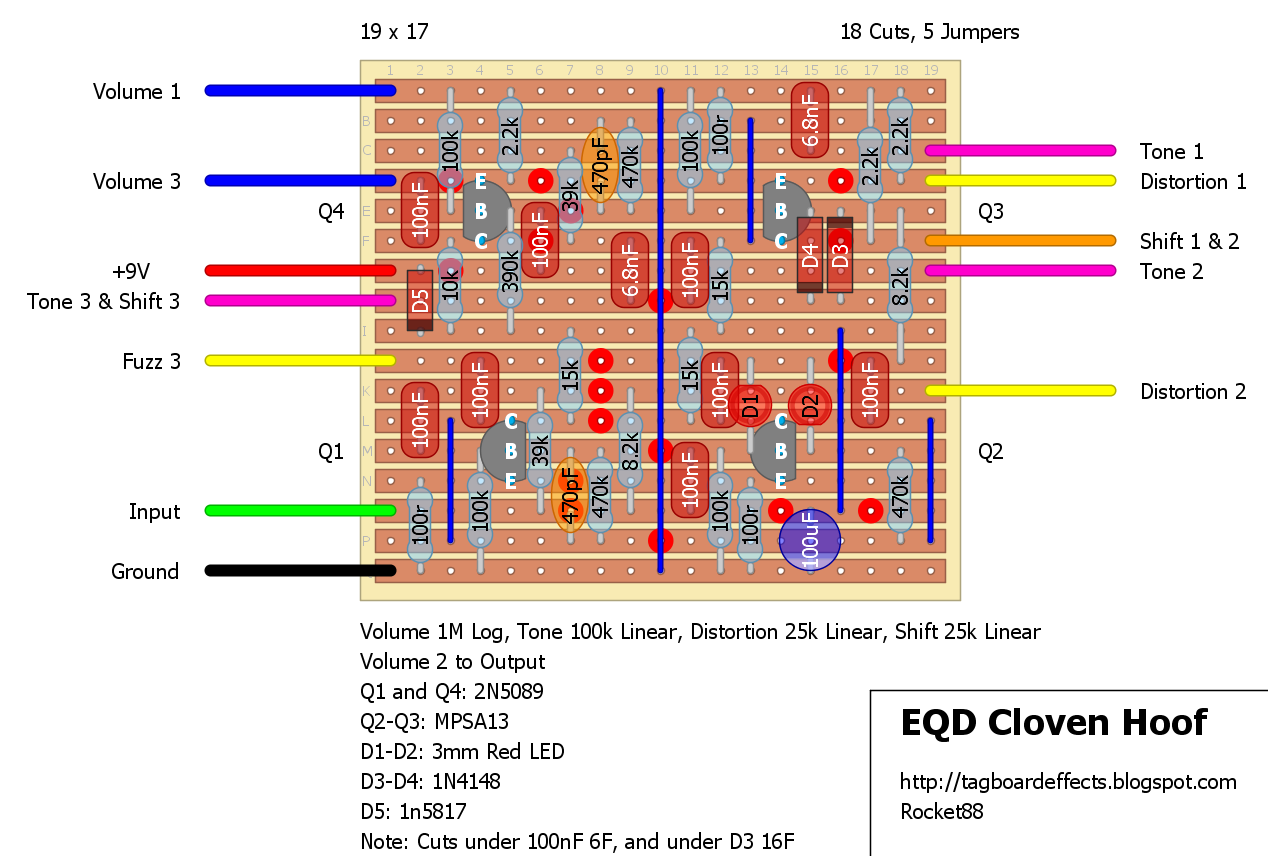
Sorry for such a long delay in publishing some new layouts, there's been a lot of changes going of for me which has taken up a lot of my time to sit and make some new layouts. Shortened version: became a doctor, had my first child with my wife, got a new job practicing, lots of home projects around the house, and COVID. Here's the first of many new ones from me coming at you. Figured I'd start with something familiar to all the fuzz lovers out there, as you can never have enough muffs. From the Source: The Cloven Hoof is an extension of Earthquaker Devices popular Hoof
fuzz, only more… cloven. Earthquaker kept the clarity of the Hoof along
with the wide range of dirt tones and redesigned everything around it.
The Cloven Hoof delivers a grittier, more bass heavy tone with more
crunch that can not be achieved with the standard Hoof. They did away
with the germanium transistors and replaced them with 4 specially
selected silicon transistors for higher gains, cleaner cleans and
improved temperature stability. The fuzz control has four times the
range of the regular Hoof, it will go from completely clean to an all
out fuzz fury with more grind at the top end of the dial. The tone
control has been refined to allow a more even sweep with enough mids to
handle all the additional low end. The shift control still boosts or
cuts the mids and there is still a TON of output on tap. The Cloven Hoof
is the perfect solution for those of you who always wished the Hoof had
more. Each Cloven Hoof is made by hand in the majestic mountain top
village of Akron, Ohio.
Controls
Fuzz: Clockwise for heavy, counterclockwise for light. Tone: Bass to the left, Treble to the right. Level: Use this control to make the Cloven Hoof louder or quieter. Shift: This adjusts the mid content, clockwise for scooped mids, counterclockwise for boosted.
"The Space Spiral is a dark and dreamy modulated delay designed to take you across the highways of fantasy. While the delay may be designed around a “dawn of digital” echo processor, the sound is out of this world, man. If you are a fan of the dreary echoes produced by old oil can delays or the ethereal sound of a well-loved tape delay, the Space Spiral is totally going to tickle your tone bone.
The Space Spiral’s delay time ranges from a tight 30ms to a fast and loose 600ms."
Schematic, pcb and info available on pedalpcb website here.
It should fit in a 125B size enclosure.
Original Info: The Warden is an optical compressor with a feature set usually
reserved for studio grade units. Built with high grade components and
internally powered by 18v, The Warden has loads of gain and sustain on
tap. With complete control over attack, release, sustain and ratio, The
Warden will allow everything from a heavy squash with fast attack and
release to “barely there” subtle compression. Optical compression has a
reputation for having more character than a VCA or FET based compression
and The Warden is no exception.
There was already an old post for this pedal that had been put on hold. It was easier to start a new one to avoid confusion I've used the schematic from pedalpcb for this layout.
"The Dunes, like the Palisades, is a Tube Screamer variant. Yet it
goes a step further from the original, adding a few extra features that
go a long way to matching your guitar and pickups, to your amp. The
knobs are familiar—Tone, Gain and Volume. In addition, there are three
toggle switches that really make things interesting:
Voice: Gives you three tonal differences; MOSFET, Silicon and Normal.
These options give you different levels of compression when adding gain,
and really change the overall character a lot. The Normal setting has
little to no compression if that is desired.
Normal/Bright: Works great when using either darker humbuckers—switch
to Bright, or if using single coils, keep it normal. Using the master
tone control in conjunction with this switch gives you a lot of useful
variation.
Bandwidth: What a traditional Tube Screamer lacks—here, the Dunes gives
you the option of adding a lot of deep low end—great for single coils,
or switch it back to the more traditional screamer mode, accentuating
the midrange, with less emphasis on the bottom end."
PCB and schematic available on PedalPCB website here.
Had a sleepless night, so I decided to knockout some new layouts before the end of the new year. This one kicked my ass a bit, but I got it as small as I could. a nice sounding delay, that's similar in architecture to the Deep Blue Delay. It's a nice sounding warm, natural delay.
From the source: The Disaster Transport JR is an analog voiced digital delay with 625ms
delay time with an all analog dry signal path and true bypass switching.
It was designed as an anti-modern delay for those who appreciate a nice
vintage tape echo with all it’s peculiarities. Its unique tone control
doubles as a noise filter on longer delay settings and really helps the
delay shine with a dirty signal. The mix control allows you to boost the
effected signal to nearly 4x the original signal level and the repeats
control goes from one signal repeat to near infinite repeats all the way
through to self oscillation.
Controls Mix: Sets the
output level of the effected signal. This should be treated as a gain
control/master volume for the delay line. Unity is around noon and
everything above noon will boost the delayed signal louder than the
original. This is a gain control so, like any pedal with a lot of gain, a
hint of noise and distortion at max setting is completely normal.
Tone:
Most delay pedals are heavily filtered at the output to remove the
clock noise and other unwanted hash that is common from extending the
range of the delay time beyond the limit of the circuitry. This usually
leaves the delay sounding dark, muddy and disappear when hitting it with
dirt. The Disaster Transport has done away with a lot of the heavy
filtering and replaced it with a tone control which allows the user to
choose their desired sound and results in more natural tape-like
repeats. The tone control is at it’s darkest fully counter clockwise and
brightens as you turn it clockwise. A good rule of thumb is to leave
the tone control between off (fully counter clockwise) and noon at
longer delay times. This will remove all the common noise from
hyper-extending the circuit.
Time: From about 30ms fully counter clockwise to about 625ms fully clockwise. Repeats:
Sets the regeneration of the delay line. From one single repeat fully
counter clockwise, subtle repeats around 9 O’clock, strong naturally
decaying repeats at noon, near infinite repeats around 2 O’clock and
full on self oscillation fully clock- wise.
Original:
Tails:
A version of this pedal was requested with tails, so I took a look at the Deep Blue Delay, which this is based off of, and made the same modifications. To have tails, you don't use a 3PDT switch and the usual stomp
switch wiring, you're going to use a DPDT switch with the input and output wires going
directly to the sockets. With tails the stomp here will cut new signal going into
the PT2399 and so when bypassed the output of the PT2399 will continue repeating with the last input it received and the repeats continue, and IC1 will then act as a buffered
bypass. You may want to to swap the 47K resistor at pin 7 of IC1
for a 50K trimmer so you can adjust the buffered bypass level so you can have to
perfect unity with your bypassed signal. Another alternative is that you
can add a second stomp to true bypass the whole thing which will give you the option to mechanically bypass the effect as usual, or simply bypass with tails when you want.
Original info:
"The Palisades is something we said we would never do… an overdrive
based on the legendary TS808! Gasp! The horror! Another tubes creamer??
In 2014?? Really?? After loads of requests we finally buckled. We ran
tests with every popular clone on the market as well as several vintage
originals, compared, contrasted and took loads of notes. It was
exhausting but informative. In the end, we threw it all away, used our
ears and came up with what we feel is the most versatile relative of the
808 available today. With 6 different clipping voices, 5
bandwidth settings and 2 gain channels you will be hard-pressed to not
find a setting that will wipe every mid-boosting overdrive off your
board. The clipping voices determine how transparent and open or tight
and crunchy the distortion is. They will vary drastically depending on
where the gain is set, what channel is active and how much bandwidth is
being used. The bandwidth sets the frequency response of the distortion
and goes from thin, light and clean through fat heavy and crunchy. It
may very well be the single most important control the palisades has and
what really sets it apart. Gain A is a lower gain channel with a
wider range of grit that is great for strumming open chords. Gain B is a
higher gain channel with a tighter range that is great for palm muting
and/or shredding solos. The Palisades also has a foot switchable volume
boost with adjustable level to take it over the top when you want to
throw your foot up on the monitor and rip your sweet leads… or maybe
just push the front end of you amp a little harder. Not enough? How
about a normal/bright switch to mix and match the overall tone to
different amps and guitars. Still not enough? OK then, how about a
buffer on/off switch to tighten up the tone and make it sparkle when set
to “ON” or warm it up and make it sag when set to “OFF”." Original FSB thread and schematic (still unverified) available here.
This ll discrete, MOSFET based circuit provides nearly 30db of
unadulterated clean gain boost with a minimum amount of tone coloration.
Note that you can also use this as an attenuator by turning the Boost
knob counterclockwise away from the noon position. It can also be used
as a powerful buffer with an input impedance of around 5M Ohms and an
output of around 1K Ohm, best used after your effects chain. This device
does not create distortion or overdrive on its own. However, it can be
used to drive your favorite amp or pedal into singing distorted sustain.
Simple, yet effective. Top notch components and circuit design assure
that your signal arrives to its destination in a truly pure state.
When you look at the circuit you can see it's basically a modified SHO.
Basically the Tentacle is Dan Armstrong Green Ringer with a few value changes.
Now for those of you that liked the idea of building a Hoof Reaper, which I mentioned when I posted the layout for the Tone Reaper, the Tentacle should go in between the Hoof and Tone Reaper for the Octave effect. So for all the disciples of fuzz out there, pair this your favorite fuzz for some crazy octave up fuzzy goodness.
Direct from the source:
The Tentacle is a classic analog octave up effect. It is the very same
octave from our beloved Hoof Reaper pedal. We got so many requests to
make this a stand-alone unit that we just had to make it a reality. You
can now add an excellent, swelling octave up to anything your heart
desires! Pair it with your favorite fuzz, strap on a headband and
unleash your inner Jammy Hendrix. Put it in front of another octave up
and blow your amp's mind. Throw it in the effects loop of a delay and
marvel at what happens (then tell us, we’d like to know too). What’s
better? It has no controls! Nothing to worry about at all here, just hit
the switch and go for it. The Tentacle is an analog octave up, the
effect will become much more pronounced when using your neck pickup and
playing above the 12th fret.
Edit: For those that have built this already based on the original layout upload, flip Q2 so the Emitter is towards +9V and the Collector is towards Ground.
Ahoy! Welcome to your new Depths Optical Vibe Machine! The Depths is
our take on the classic optical vibe circuit. Now you can swab the decks
with the same lush, pulsating, three-dimensional swirling sound you
know and love, with some modern accouterments for all you land-lubbers
out there.
The Depths is optimized for use with all kinds of
instruments, pickups, and to play well with dirt, so nobody’s left
waiting on shore. If it’s got a ¼” output, plug it in and get deep!
In
addition to the classic vibe controls, the Depths features unique
controls for “Voice” and “Throb.” The “Voice” control adjusts the
midrange focus of the Depths, which is perfect for tailoring the effect
to your particular instrument. Clockwise, you’ll hear a fuller sound
with a low-end focus. Counter-clockwise, you’ll hear a thinner, spikier
sound with a forward upper-midrange bite. The “Throb” knob adds a hefty
subharmonic low-end pulse to the vibrato signal, which is especially
useful on synthesizers and the bass guitar. It sounds great with a
little bit of dirt on the neck pickup of a guitar, too! This works best
with the “Voice” turned counter-clockwise for a warmer tone.
The
Depths’ “Intensity” and “Rate” controls are dialed in to give you the
classic optical vibe sound at more modest settings, but dive in deeper
and you’ll find anything from a smooth ultra-slow warble to sharp,
speedy bursts! Also, the “Level” control has tons of output above unity
on tap to combat the perceived volume loss of most vibe pedals, so your
tone is always above water. And, if 9v isn’t enough to keep you afloat,
the Depths may be powered at 18v for a stiffer tone with more headroom
and sparkle.
We've got 2 layouts for you.
Layout 1: We've got the the LFO off the main board to hopefully prevent the dreaded LFO tick. Should fit in a 125b like the original. Downside is that there is more offboard wiring you will need to do.
Layout 2: Slightly larger board, with the LFO on the main board. You shouldn't get any ticking, and you'll save on having to deal with the extra offboard wiring.
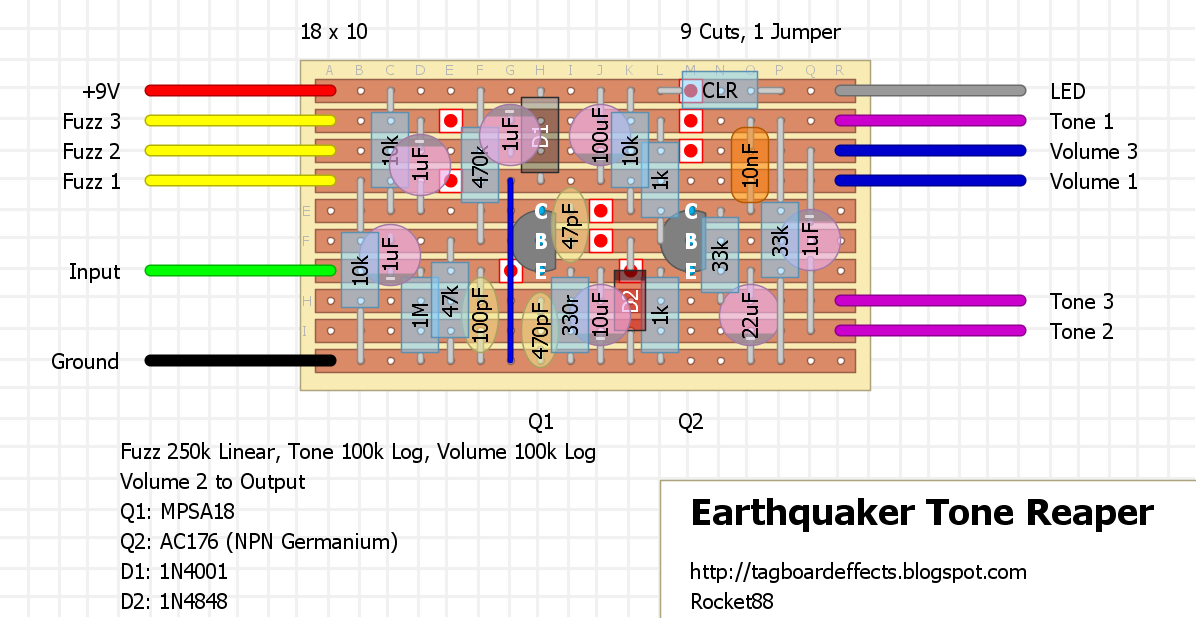
The Tone Reaper is a vintage style fuzz device based on the “3 knob”
bender. It’s a silicon/germanium hybrid capable of producing an array of
tones from every bender era with careful tweaking of the tone and fuzz
controls. From thin and spitty to a growling crunch, all with a midrange
punch to make it scratch and kick through any mix. The Tone Reaper will
also please anyone looking for the higher gain Randy Rhodes style grind
at it’s higher fuzz settings. All analog, true bypass and made one at a
time by real humans in stuffy Akron,
Basically it's a modified Tonebender MKIII, with the biggest change being the Germanium darlington pair normally in Q1 & Q2 being replaced with a high gain Sillicon transistor.
Thanks goes to Galapagos, who traced his Tone Reaper, schematic and trace here. You'll notice there's a diode he marked mystery, which from what I can tell looks like a 1N4848/1N914, so that may take some experimenting. Also, without knowing the hfe and leakage of the AC176, I can't say for sure what would be a good substitute, but you may want to try the typical NPN Germaniums typically use like MP38A, but these typically have little to know leakage while the original tonebender Q3 likes a lot of leakage.
Side comment. For those that want to have some more fun, you can build the Tone Reaper and put it in front of a Hoof, each on their own switch and make 2/3 of the Hoof Reaper, as we don't have a schematic for the switchable octave in between.
EDIT: for all those that want to make a Hoof Reaper we have a layout for the octave section, as it's the Tentacle. Build on Brothers of Fuzz.
A dual overdrive based on the classic grey spec DOD 250.
The schematic didn't come from the original EQD pedal.
David has recreated the circuit on his website (Perf & PCB Effects Layouts).
You can find his original and verified layout here.
Madbean's great new project based on Earthquaker Devices Sea Machine.
Original infos available here.
17/07/2016 Layout updated!
Changed 33n cap to 3n3 and 10k resistor from PT2399's pin 14 back to 1K.
Original infos: The Acapulco Gold is a dirt-simple power amp distortion device that's
based on the vibe of a cranked Sunn Model T. You know what is awesome? Simplicity. One
button, one knob. How loud would you like it? Just move the knob. This
is the spirit of rock and roll. Quit turning knobs and play that guitar
like you mean it. While playing, you may want to try ignoring our suggestion and try
fiddlin' with your guitar's volume and tone knobs as these can
drastically affect the sound of the Acapulco Gold. The volume knob on
your guitar cleans up the pedal nicely, but not too clean. At minimum
guitar volume settings, the Gold imparts a hazy, Nashville-sounding
spank to your tone. At just-barely-backed-off, the Gold turns into a
raunchy overdrive. And of course when the guitar volume is completely
open, the Gold roars like a Model T on the verge of explosion. It's not
quite fuzz, but so close. This is a very loud pedal. As Nocentelli pointed out on the original FSB thread here, there are 2 types of videos: a carefully produced one from PGS (where it's probably used to massively drive a nice tube amp)
and a more realistic one where the volume knob is set much lower
Info about the original: The Talons is an extremely versatile high gain overdrive that serves up
the full range of gain from transparent boost to heavy saturation, and
all points in between. Unlike all our other overdrives, the Talons was
not designed to emulate any specific sound or era. The presence control
gives you a wide range of top-end contour and the active 3 band EQ
allows you to sculpt your tone to perfection. The Talons can be powered
at the standard 9v for a warmer amp-like tone or at 18v for greater
headroom, more volume and a brighter, stiffer grind.
Hi guys! Alex here and I'm very excited to join the
tagboardeffects squad. Thanks to Mark and Miro for the opportunity, and
thanks to Travis, Zach and Javi for joining along.
My first contribution to the main site is a great guitar synthesizer from EarthQuaker Devices.
I would like to thank Njokki for reverse-engineering his original pedal.
Info about the original: The Bit Commander is a monophonic analog guitar synthesizer with four
octaves of vintage square wave synth tones. Its no-nonsense interface
makes it easy to add or subtract octaves to create a wide variety of
sounds without having to dial in envelopes or oscillators. Ripping
sub-octave thump, pulsing octave down, a lightly squared base tone and a
swelling transformer based octave up all join together to make a single
guitar sound like an army of olde tyme synths.