Showing posts with label Splitter. Show all posts
Showing posts with label Splitter. Show all posts
Tuesday, 5 August 2014
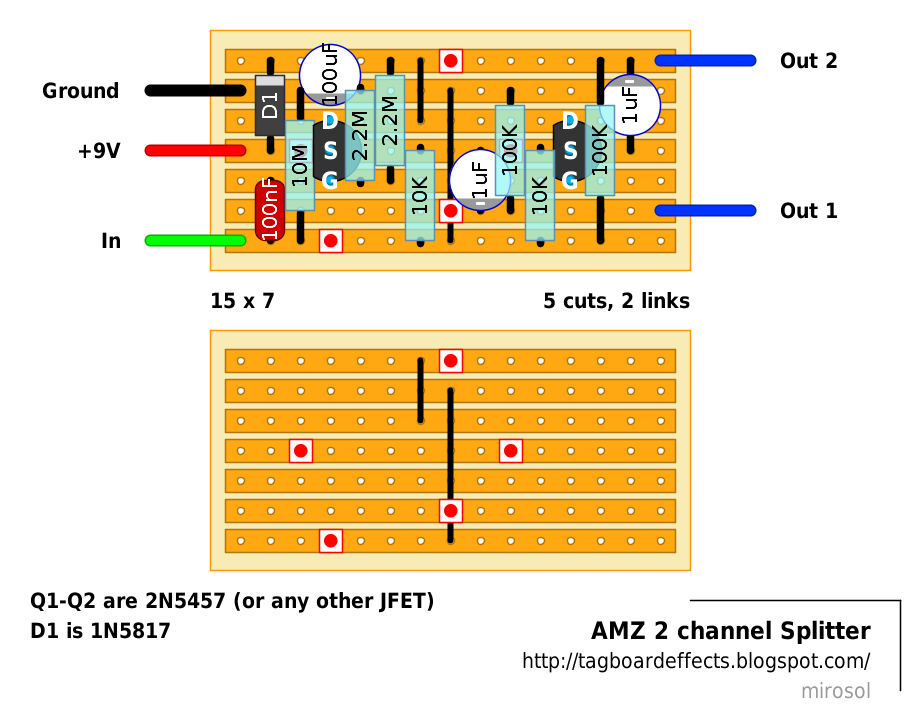
AMZ 2 channel Splitter
Had drawn this a long time ago and even build a few for my personal use. AMZ buffers are known to be very good in sound quality, so the splitter is that too. It is very modular and it can have as many output channels as needed. The most common use would still be to have simple splitter - one input and two independent outputs. I used this circuit the last time i was in studio to gain two separate signal paths to two different amplifiers. We already have mixers and other utility boards listed, so i think it's time to have this one too. It'll be nice fit to 1590A box.


Thursday, 2 May 2013
Opamp 3 channel splitter/mixer ON HOLD
Updated 6th February 2014
I have a TC Electronic G-Force and Eventide Eclipse in the parallel effects loop of my amp and use a rack mixer to keep them in parallel with each other, and so allow me to use them both 100% wet and so avoid having to digitize my dry signal. I do have OCD about keeping my core dry signal out of the digital domain completely.
But I also have an Eventide Pitchfactor and would like to put this in too, and although the rack mixer can accomodate 4 in and 4 out, adding the Pitchfactor to an already limited rack space would be a pain, so I wanted to make a little 3 channel utility splitter/mixer to use instead of the rack mixer to save 1U and allow me to put two pedal trays in my 6U rack.
I used the splitter scheme you can see at Paul in the Lab, and a generic mixer circuit I found so that everything can be done with one quad opamp. I may even make this with 3.5mm jacks for the send and returns, make up my own high quality cables and then this will all fit comfortably in a 1590B. It would pretty much be a set and forget utility for me so I suppose I could even use trimmers instead of pots, set the levels and tuck it away somewhere. So I thought I'd add it here and it may be useful for others to adapt for their own uses.

I have a TC Electronic G-Force and Eventide Eclipse in the parallel effects loop of my amp and use a rack mixer to keep them in parallel with each other, and so allow me to use them both 100% wet and so avoid having to digitize my dry signal. I do have OCD about keeping my core dry signal out of the digital domain completely.
But I also have an Eventide Pitchfactor and would like to put this in too, and although the rack mixer can accomodate 4 in and 4 out, adding the Pitchfactor to an already limited rack space would be a pain, so I wanted to make a little 3 channel utility splitter/mixer to use instead of the rack mixer to save 1U and allow me to put two pedal trays in my 6U rack.
I used the splitter scheme you can see at Paul in the Lab, and a generic mixer circuit I found so that everything can be done with one quad opamp. I may even make this with 3.5mm jacks for the send and returns, make up my own high quality cables and then this will all fit comfortably in a 1590B. It would pretty much be a set and forget utility for me so I suppose I could even use trimmers instead of pots, set the levels and tuck it away somewhere. So I thought I'd add it here and it may be useful for others to adapt for their own uses.
Saturday, 18 February 2012
Split 'n' Blend
I like these little "utility boxes"
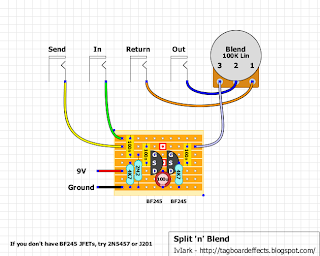
(Please take note! This circuit will not work as a blend for pedals that invert the signal polarity (or phase). For a few examples of such pedals; the likes of Dyna Compressor/Ross Comp and their derivatives and Marshall Bluesbreaker among others. The symptom of inverted signal polarity (phase) will be significant drop in level when the blend pot is set near its middle position. This is caused by two polarity phases cancelling each other out. If you need a way to control the phase, then you need to address this accordingly.)

(Please take note! This circuit will not work as a blend for pedals that invert the signal polarity (or phase). For a few examples of such pedals; the likes of Dyna Compressor/Ross Comp and their derivatives and Marshall Bluesbreaker among others. The symptom of inverted signal polarity (phase) will be significant drop in level when the blend pot is set near its middle position. This is caused by two polarity phases cancelling each other out. If you need a way to control the phase, then you need to address this accordingly.)
Monday, 23 January 2012
Mini JFET Blend
A simple mini blend layout based on Sean's JFET schematic here:
http://seanm.ca/stomp/minblend.html
Will easily fit in a 1590A box and I probably wouldn't even use a stomp switch with this because in the unblended position of the pot, this will essentially be just a JFET buffer. You could always add a mini toggle to bypass it completely if you wanted to.
This will make a useful little tool to experiment with blending dry and effect signals together, or to allow you to use a digital effect 100% wet so your dry signal isn't being digitised.

http://seanm.ca/stomp/minblend.html
Will easily fit in a 1590A box and I probably wouldn't even use a stomp switch with this because in the unblended position of the pot, this will essentially be just a JFET buffer. You could always add a mini toggle to bypass it completely if you wanted to.
This will make a useful little tool to experiment with blending dry and effect signals together, or to allow you to use a digital effect 100% wet so your dry signal isn't being digitised.

Saturday, 13 November 2010
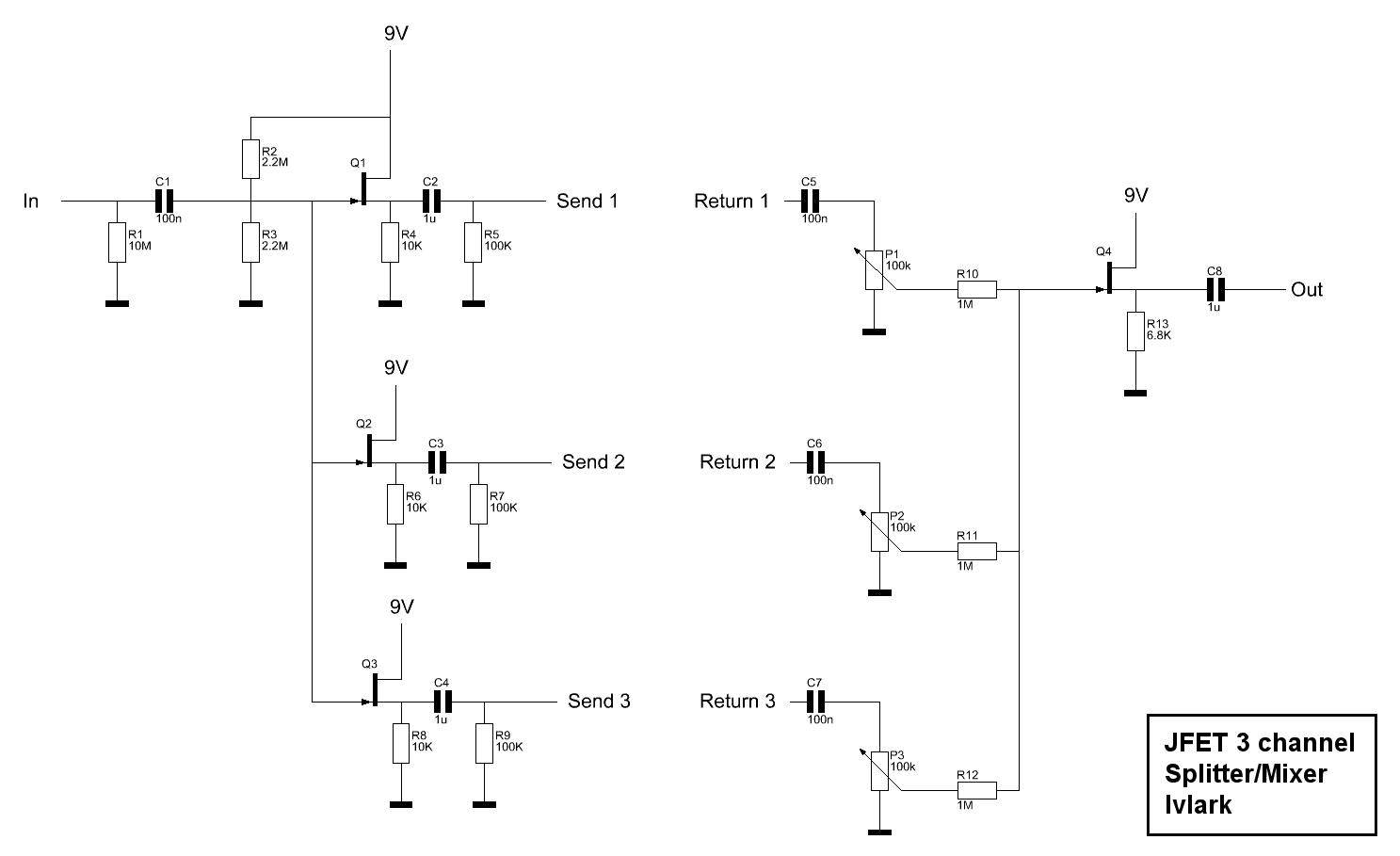
JFET Parallel Looper

This is one of those versatile builds that could be useful for a number of different tasks. Effects and dry signal in parallel, 3 channel splitter/mixer, 1 input 3 outputs for using multiple amps, 3 inputs into one output to use multiple instruments, convert serial effects loop into parallel ... and so on. I made it 3 channel so I could put two mono effects in parallel and then have the third channel to pass the dry signal via a patch lead if I was using digital effects and wanted them wet only, so as not to digitise the main dry signal. It can be easily adapted for more or less channels depending on what would suit you.
Based on the AMZ splitter and a generic JFET mixer circuit.
Monday, 5 July 2010
Guitar and Bass Paralooper
From Moosapotamus:
Pots are 100K lin for Blend and 100K log for Volume.


The ParaLooper is something every effects-using Bass player should have, because it will 'Bassify' any bottom sucking, high-passing guitar pedal out there. And, it's pretty simple to build, too. Instead of just an effect loop pedal, this is actually a little mixer that blends your straight signal with whatever effect (or chain of effects) you plug into the send & return jacks. There are controls for wet/dry balance and overal output level (boost & cut).
Experimenting with parallel effects chains a snap, in mono or stereo. For example, you can plug whatever effect(s) you have connected to the send into a second amplifier or mixer/recorder channel. It can also be used just like a two-channel mixer itself by plugging a second source into the return jack. There is also a low-pass filter (capacitor to ground) on the clean signal that can be switched in for even more low end.
Experimenting with parallel effects chains a snap, in mono or stereo. For example, you can plug whatever effect(s) you have connected to the send into a second amplifier or mixer/recorder channel. It can also be used just like a two-channel mixer itself by plugging a second source into the return jack. There is also a low-pass filter (capacitor to ground) on the clean signal that can be switched in for even more low end.
Pots are 100K lin for Blend and 100K log for Volume.
Full Range version

Bass version

Subscribe to:
Posts (Atom)