Showing posts with label Booster. Show all posts

Sunday, 2 January 2022

FAL Treble Boosters

 Found these posted by the one and only pinkjimiphoton on the usual places. Both are very old and rare always on fixed treble boosters. Should be quick fun small builds. You can easily make them NPN by flipping the electrolytic caps, power and ground connections. I believe low gain transistors will work fine in them.


FAL Treble Booster 1967


FAL Treble Booster 1969


Sunday, 12 July 2020

DOD 210 FET Preamp

Surprised this one hasn't been done. A nice small and quick build, and should have lots of boost on tap and fatten up your tone nicely. Could be a good platform to mod to taste. Seems to be on the rare side to boot. Only video I could find was a DIY build that has some mods, but you get the idea.


Saturday, 16 November 2019

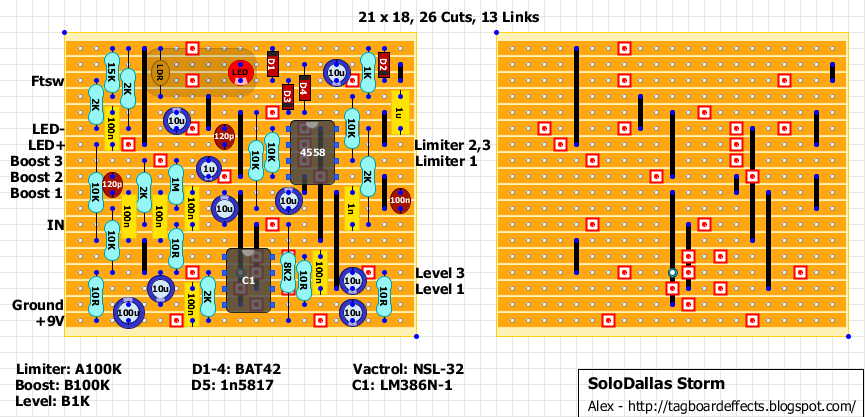
SoloDallas Storm

"This all-analog unit is a reproduction of the tone enhancing circuitry contained within the most widely used wireless system throughout the 1970's to mid 1980's, the Schaffer Vega Diversity System (SVDS). Emphatic users of the SVDS included Angus Young, David Gilmour, Eddie Van Halen, Carlos Santana, Peter Frampton, Peter Green, Joe Walsh, Don Felder, Elliot Randall, Jerry Garcia, Bob Weir... and an endless list of legends who are responsible for some of the best guitar parts ever recorded."
Schematic available here.


Saturday, 23 March 2019

ThroBak Strange Master

From the Source:

The Strange Master treble booster now includes both Germanium and Silicon transistors. These transistors are switchable so the user can now get classic Dallas Rangemaster treble booster Germanium tones and higher gain Silicon treble booster tones from one pedal!

ThroBak guitar effects pedals offers another classic Signature Sound effect with the Strange Master Treble Booster, a recreation of the Germanium Dallas Rangemaster Treble Booster used by Eric Clapton, Brian May and Tony Iommi.

In keeping with our ThroBak Guitar effects pedals Signature Sound philosophy Strange Master treble booster offers user adjustments to shape the sound of this effect. Jimmy Page, Jimi Hendrix and Brian May had Roger Mayer and Peter Cornish customize their effects to create their own signature sound. We give this control to you.

As far as we can tell we are the only company offering a Dallas Range Master clone with a bias adjustment. This  allows you to change the character of treble boost from loose to tight. Switchable range allows treble boost and mid boost germanium distortion. Recreate the Clapton Beano tone or the singing overdrive of Brian May to the growl of Tony Iommi with this pedal, its all in there.


Basically, the Strange Master is a Rangemaster with a switch allowing you to selecting between 2 input caps (Treble and Full) and another switch to select between transistors (Germanium and Silicon), and a bias pot to adjust the bias either between the germanium and silicon transistors or give it a little grit.

Keep in mind that the gain of the transistors is going to be paramount in getting it to sound good. I would suggest looking for gains in the 100-120 hFE range for the germanium (just like a regular rangemaster), and something around 250 hFE for the silicon. Also you can play with the input and output caps to get more or less bass. You can also change the Hi/Low switch for a pot to give you a sweep between the 2 input caps.


Wednesday, 27 September 2017

Nine Volt Nirvana BrontoBoost

Next up of the Nine Volt Nirvana pedals is the BrontoBoost. From Joe.

The new Brontoboost is a two stage booster/fuzz/OD/Dist unit that has a ton of different tones in it, all good! It goes from awesome treble boost like a British top booster, to fullrange boost, to very fat fuzz and everything in between. The fuzz can be set to 'sick', which sounds like an amp on the verge of meltdown! The Brontoboost features tremendous sustain, with a fuzz character that is textured and harmonically rich without sounding like existing fuzzes. Be careful, playing in this compressed , swirly fuzz mode can be addicting, and might bring out a whole new side to your musical expression! "The Bronto is a versatile beast, and has a character unlike any other pedal on the market. Some people simply don't like it, others think it is the most brilliant thing they have ever played! Weird. It does four things, and all of them very well:
  1. Cleanish boost [treble boost or full range]
  2. OD, like a TS, but with a much more open and natural feel - responds to your playing in a very satisfying way. Wider freq response than a TS or most other pedals on the market due to the 'quad cap' circuit path - this adds dimension to the freq response.
  3. Fuzz - mild fuzz all the way to 'amp meltdown' sound. different than any other fuzz I have heard, - compressed yet articulate. Smooth yet alive. Sustain and clarity amidst the fuzzfrenzy . Weird but beautiful.
  4. Tube amp simulator. I use mine on low volume gigs to replicate the breakup of a tube amp. People are amazed a the tones that are achieved at low volume with it. Like our favorite all time great rock guitar tones but at a very reasonable volume!
The other great thing is that at all settings, it retains an incredible 'gain' control - your guitar 's volume knob! I use the Bront on about 80% of all my guitar work these days due to this versatility. Swiss army knife of preamp/OD/Boost/Distortion/Fuzz."
Quick note: Q3 is Ge, so I assume you can sub the 2SB54 for any other PNP Germanium transistor.


Nine Volt Nirvana Tape Measure Boost

I came across some a bunch of schematics for Nine Volt Nirvana, Joe Gagan's old company. While I haven't found any videos for all of them to get an idea of the tone I can guarantee that if Joe Gagan designed it it's gonna sound awesome.

First up, the Tape Measure Boost. The schematic calls for a trimmer for the volume, I believe the idea is to have it as a set boost inside another pedal or stand alone unit, but I thought it would be nice to have one with a volume pot instead. You can also sub the 2N2222 with any other common NPN Si transistor (2N5088, BC108, 2N3904, etc.)

Original
Added Pot


Thursday, 13 July 2017

Standard Hemmo Fuzz/Booster w/ mods

Found an old schematic of Standard Hemmo Fuzz, which has two outputs. One for cleanish boost and second for fuzz. Drew it as described and added diode clippers as notes suggested. Added volume pots for both modes, 2PDT stomps for mode select and basic bypass. Some of you might find this rather usable...


Wednesday, 3 May 2017

LEHLE Sunday Driver

From the Source:

The Lehle Sunday Driver SW is a compact-format high-end preamp for all types of electrical and acoustic instruments - a preamp that enables electric guitars and basses, acoustic guitars, and also other stringed instruments (such as violins, cellos and double basses) to realize all of their musical potential. The switchable version expands the classical Lehle Sunday Driver's features by an On/Off footswitch. 

The Lehle Sunday Driver SW, with its high-quality JFET technology, provides two operating modes. In D (= Driver) mode, the input signal is amplified with zero modification, to eliminate the signal losses that long cable routings and/or effects chains can cause. The signal remains powerful and clear, and retains its dynamics. Mode S (= Sunday) multiplies input impedance by four, bringing out previously inaudible details and, as gain increases, imparting to the guitar a characteristic and unmistakable warmth. There is no distortion at any stage, and the signal always stays clean, even at a maximum gain setting of 15 dB. Thanks to its studio-standard signal-to-noise ratio of better than -100 dB, the Lehle Sunday Driver SW is totally free of background noise. To exploit the dynamics of tube amplifiers to the full, the input voltage is also rectified from the power supply socket, then filtered, stabilized and doubled to 18V. 


In OFF status, the Lehle Sunday Driver SW provides two different modes of operation - in TB (= True Bypass) mode, the input and output are linked with zero losses to one another via a switch with gold-plated contacts. True Bypass mode is the best option for a small set-up with short cable routings and for when a treble-booster or a classical fuzz pedal is looped in after the Lehle Sunday Driver SW. The line-driver function, located at the start of the train or in an effect chain, is the better solution for long cables and for complex effect board configurations. Switch the Lehle Sunday Driver SW to TS (= True Sound) mode, and it is active as a buffer, without amplifying or modifying the signal in any way. In this mode, the Lehle Sunday Driver SW operates as a totally neutral line-driver – equivalent to Mode D with the gain pot turned all the way to the left. The Bypass mode option enables the Lehle Sunday Driver SW to integrate ideally into any set-up, whether as a battery-operated stand-alone unit, or in an existing pedal board. 


Note: I removed the odd power network, which consisted of a diode rectifier and regulator, which should not be needed since it's supposed to run on +9VDC not +9VAC. According to the site, they claim there's a TB/Buffered switch which is not included on the schematic, nor did I see it on the PCB over at FSB when it was reversed engineered.

Tuesday, 2 May 2017

Hornby Skewes Bass Boost

Another super rare Hornby Skewes pedal, so rare in fact I can't even find a video for it. Similar to the treble booster, but boosts the bass frequencies instead of the treble. I'm certain just like any other vintage Hornby Skewes pedal it's gonna sound great.

Layout 1: Original PNP


Layout 2: NPN Version


Hornby Skewes T.B. 2 Selectatone

Another classic. Not much info on this one either. It's super rare, just like 99% of the Hornby Skewes pedals. Essentially, it's a set booster that you can switch between either bass or treble boost. Rumor has it that it was used by Ritchie Blackmore during the 1960s up until 1974, as well as Jethro Tull on Aqua Lung. Schematic is over at FSB.


 Layout 1: Original (PNP)


Layout 2: NPN


Sunday, 30 April 2017

Hornby Skewes Shatterbox

The Hornby Skewes Shatterbox is another stupid rare fuzz/booster made in the 60's, need I really say any more? In case I do, info is not really available on this monster, but here's what I found:

Skewes Shatterbox Produced in Leeds circa 1966, the unit combines two effects; The JHS Zonk fuzz and a Treble Booster circuit, the original unit was produced in exceptionally limited numbers and was famously used by Mark Bolan T-Rex.


Layout 1: Original PNP


Layout 2: NPN Version


Layout 3: Original with LED


Layout 4: NPN with LED


Sunday, 16 April 2017

Way Huge Tone Leper

Once again, not much info on this one, but was made way back in '92 and for a limited run. It's a booster that's more of a midboost/cocked wah tone. Unfortunately, there's 0 videos I could find of it, but once again if it's a Way Huge pedal it should be awesome. What's interesting is that it's really just an Anderton Frequency Boost.


Note: You can change the 2 22nF caps to one of the other value options from the Super Tone Leper if you choose to change the frequency of the boost.

Figure while I was at it I might as well do a layout for the Super Tone Leper that Mr. Huge had made for Queens of the Stone Age back in the day. Same effect, but with 5 different frequency selections.


One more layout with the additional cap for the frequency selection caps. I added a pair of 3.3nF for a treble setting like Ryan suggested below. You can obviously mess with the caps and find those that you prefer.
 

Wednesday, 12 April 2017

Way Huge Angry Troll

So I randomly stumbled across the schematic for this one over at FSB and as always thought it would be a nice addition. Just like any other Way Huge pedal I think it sounds badass.

From the Source:

The mighty Angry Troll Linear Boost Amplifier from Way Huge Electronics serves up generous portions of volume and gain to pummel the input of your amp with up to +50dB of gain. It adds bite and punch while transforming your mild mannered tone into a beastly sonic onslaught! The Angry Troll's two controls interact like a vintage mic pre amp. The Anger knob-a rotary switch with six Fists of Fury positions-adjusts the amount of gain created by the Troll's op-amp, while the Volume knob regulates the overall output level. High grade components are used for a precisely tuned circuit that works like an extension of your amp. Another tone monster from the mind of Mr. Huge!


Layout 1: Stock Normal Layout


Layout 2: Was kinda requested below. Modded to remove the fist switch, which controls the gain, and replace it with a pot. Quick note about this is that the way the switch is wired when it's at position 1 it has the most resistance allowing a clean tone. according to my calculations at Sw1 there should be 62.5k resistance, and since there's no 62.5k pot you could use a 100k or 50k pot. Nice thing about doing this is the board shrunk, all pot wires are connected to the board, will give more options for grit, and it should be a stupid simple build.


Monday, 10 April 2017

Schaller Treble-Bass Boost

Not much info on this but, it's a rare West German Schaller vintage “Treble-Bass Boost” from 1968. It typically goes for over $400usd, so fairly desirable. It's a 2 transistor based booster, with a five position switch that controls the the frequencies being boosted. There's 2 treble settings, 2 bass settings, and 1 mids setting. Seems like it also gives a little bit of drive too, which is a nice addition.


Thursday, 2 March 2017

Earthquaker Devices Black Eye

From the source:

This ll discrete, MOSFET based circuit provides nearly 30db of unadulterated clean gain boost with a minimum amount of tone coloration. Note that you can also use this as an attenuator by turning the Boost knob counterclockwise away from the noon position. It can also be used as a powerful buffer with an input impedance of around 5M Ohms and an output of around 1K Ohm, best used after your effects chain. This device does not create distortion or overdrive on its own. However, it can be used to drive your favorite amp or pedal into singing distorted sustain. Simple, yet effective. Top notch components and circuit design assure that your signal arrives to its destination in a truly pure state.

When you look at the circuit you can see it's basically a modified SHO.


Tuesday, 21 February 2017

Frequency Central Promiscuous Girlfriend

Another tube booster/overdrive created by frequency central over at FSB, schematic.

What does it do? Well it does clean boost with the Gain set at minimum, flick on the Dirt switch and you get some nice diode clipping too. Turn up the Gain and you'e into overdrive territory with diode clipping, flick the Dirt switch off and you get even more overdrive. All with some nice tonal variations courtesy of the tonestack, typical Big Muff Pie Tonestack. You can easily tweak the tonestack to taste.

You can also try different diodes for D5-D6, keep in mind when they are engaged you will loose some output, but there should be more then enough output with them engaged. What may be a nice tweak is to change the Dirt switch to a pot so you can control how much of the signal gets clipped by the diodes.

I opted to have the power on a separate board to help avoid issues with interference with the rest of the circuit. Make sure you are rated at least 50V due to the increased voltage from the doubling at the powerboard, which gives out approximately +35V. Also, on the power board you'll notice that I have 2 connections for the heater pins of the tubes, pins 3 & 6, but you can just run 1 wire to tube 1 then have a wire connects to the pins of tube 2.


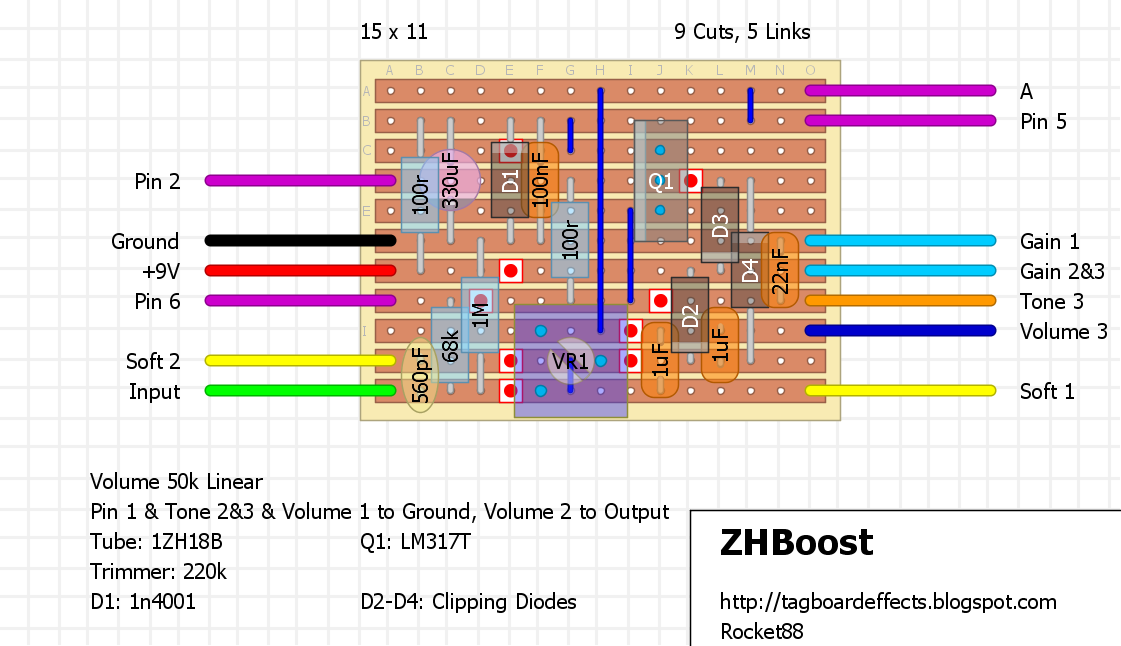
ZHBoost

Another submini tube based booster/overdrive pedal created by himister over at FSB, schematic. Make sure you are rated at least 25V due to the increased voltage from the rectifier. An additional mod you can do is replace the trimmer with a 250k pot so you can control the distortion produced by the tube on the fly externally.

 A quick note about the power. In the schematic it states that the voltage is +9VAC, not +9VDC, but if you read through the thread himister states that he used +9VDC to test it and the pedal worked fine and correctly, which is why I put the voltage as +9VDC.


Modded with asymmetrical clipping diodes to provide some more distortion, and a gain pot that controls how much the diodes are in the circuit, similar to the Germanium Giant, as well as a basic tone control.


Modded with symmetrical clipping diodes to provide some more distortion, and a gain pot that controls how much the diodes are in the circuit, similar to the Germanium Giant, as well as a basic tone control.

Same layouts as above with the change to the power section. I decided to not include an onboard charge pump as it's just as easy to add one offboard with the available charge pump layouts on the site.

Non-modded layout:

Modded Layout with Asymmetrical Diodes:
 Modded Layout with Symmetrical Diodes:

Frequency Central Red Star Drive

A real nice booster/overdrive that's basically has a submini tube that replaced the transistor create by frequency central over at DIYSB, schematic. Make sure you are rated at least 25V due to the pedal running +12V.


Version 1: Symmetrical Clipping Diodes

 Version 2: Asymmetrical Clipping Diodes

Monday, 16 January 2017

Wren and Cuff Phat Phuk B

From the Source:


Here’s what the Phat Phuk is:
A germanium/JFET booster. A unique sounding pedal which adds a beautiful sheen to your bass’ top end and a bit of grit to the overall tone. It’s a fantastic pedal for situations where you want a lift in your overall level, during a chorus or bridge for example, with a bit of bawdy bump via the germanium transistor.

One nice feature is also the more modern JFET transistor at the input which keeps the pedal impedance-friendly when it comes to active bass pickups. This helps the Phat Phuk to remain consistent whether you put a P-Bass in front of it, or a Warwick Thumb.
Another recommended use: As a simple preamp when going direct into your DAW. Helps to de-sterilize your bass’s direct tone and add a little life before the signal is converted to ones and zeros.


Something else that was considered when creating the Phat Phuk B. Many clean-boosts offer way too much boost in my opinion. In any normal playing situation, including intentionally slamming the front end of a tube amp to induce the amp’s natural overdrive, one really only needs a hefty thump to get the job done. There’s nothing wrong with having a large amount of volume on tap, but a problem that can sometimes occur is a lack of ability to fine tune the amount of boost you want. When the sweep of the knob goes from zero to melt-down with one turn of the knob, it gets tough to really dial in a precise amount of boost. Also a slight bump of the boost knob (with a foot or nervous “live show” jitters) can send things out of control. I know because its happened to me. Went for the big chorus during a song, hit the clean boost (not mine, this was long before Wren and Cuff existed) and tore the heads off the people in the front, pissed off the sound man, and pretty much ruined that song. Therefore, the volume sweep was reduced with the Phatty. You still get a big gob of gain, and probably won’t ever need to run the pedal “at 11″, but the trade -off is worth the extra control. Just an example of what Wren and Cuff prides itself on: pedals that sound superior, look beautiful, can take a beating, and are made with the “real world” player in mind.
In other words: A meticulous attention to detail.


A few notes:

1 - I posted the trace, board pictures, and schematic in the request section, here so everyone can take a look and check the trace.

2 - the Germanium Transistor in Q2 is a Chinese Transistor with the markings removed, but what can be made out is AX9. This is PNP, but the hfe is unknown, but the good news is the schematic has been verified by JohnK, big thanks, with a PNP Germanium with 91hfe. So for now, as I put in the layout notes use a PNP Germanium with at least 90hfe, but by all means test it with other values. Don't forget that if you're using Russians that many times transistors with lower hfe seem to act similar to others of higher hfe.


Layout 1:


Layout 2:


Tweaked the layout to make the bias trimmer an external pot. I chose a linear taper as it's common to use linear taper pots for bias adjusting and the trimmer should act linearly. JohnK used a 1k reverse log pot, but I think you won't get the full range you do with the trimmer by lowering the value.

Thursday, 5 January 2017

HBE Germania

"The Germania is Homebrew's take on the classic Rangemaster treble booster from the 1960s, and offers up to 20dB of gain to drive your amp.
In its 'hi-fi' setting, you get a full range boost, but a 'lo-fi' setting offers a more focused boost in one of three frequency ranges controlled with the 3Q switch. Boost in hi-fi mode is bright, with some germanium-driven grit to it, and as you turn the knob clockwise there's a massive amount available. In lo-fi mode, the three settings offer cut in the bottom but different midrange emphasis.
This pedal works best with an amp that's already overdriven, and especially one that's dark-sounding - kick it in to take it up another level and squeeze out some harmonics - it did a fine job with our old non top-boost AC30. It's also great with a dirt pedal.
The Germania can deliver a raw and aggressive boost, but that tonal shift won't necessarily suit all amp settings, so try it out with your own." 
You can find the original FSB thread here.