Here's a collection of vero (stripboard) and tagboard guitar and bass effect layouts that we have put together covering many classic and popular effects in growing numbers. Many of these have been posted on freestompboxes.org, so check that site out for great discussions on building your own effect pedals. Enjoy the builds and please also visit us on Facebook and Twitter
"Fredrik Thordendal’s signature 33
pedal is a sonic detonator tool that will transform any amplifier into a
metal wrecking ball machine!" Schematic and pcb available on Pedalpcb website here.
Original Info: The Warden is an optical compressor with a feature set usually
reserved for studio grade units. Built with high grade components and
internally powered by 18v, The Warden has loads of gain and sustain on
tap. With complete control over attack, release, sustain and ratio, The
Warden will allow everything from a heavy squash with fast attack and
release to “barely there” subtle compression. Optical compression has a
reputation for having more character than a VCA or FET based compression
and The Warden is no exception.
There was already an old post for this pedal that had been put on hold. It was easier to start a new one to avoid confusion I've used the schematic from pedalpcb for this layout.
"This all-analog unit is a reproduction of the tone enhancing
circuitry contained within the most widely used wireless system
throughout the 1970's to mid 1980's, the Schaffer Vega Diversity System
(SVDS). Emphatic users of the SVDS included Angus Young, David
Gilmour, Eddie Van Halen, Carlos Santana, Peter Frampton, Peter Green,
Joe Walsh, Don Felder, Elliot Randall, Jerry Garcia, Bob Weir... and an
endless list of legends who are responsible for some of the best guitar
parts ever recorded."
Schematic available here.
"The Dunes, like the Palisades, is a Tube Screamer variant. Yet it
goes a step further from the original, adding a few extra features that
go a long way to matching your guitar and pickups, to your amp. The
knobs are familiar—Tone, Gain and Volume. In addition, there are three
toggle switches that really make things interesting:
Voice: Gives you three tonal differences; MOSFET, Silicon and Normal.
These options give you different levels of compression when adding gain,
and really change the overall character a lot. The Normal setting has
little to no compression if that is desired.
Normal/Bright: Works great when using either darker humbuckers—switch
to Bright, or if using single coils, keep it normal. Using the master
tone control in conjunction with this switch gives you a lot of useful
variation.
Bandwidth: What a traditional Tube Screamer lacks—here, the Dunes gives
you the option of adding a lot of deep low end—great for single coils,
or switch it back to the more traditional screamer mode, accentuating
the midrange, with less emphasis on the bottom end."
PCB and schematic available on PedalPCB website here.
Original info:
"Pigtronix FAT Drive takes a futuristic analog approach to create complex
crunch tones using CMOS clipping and a variable low pass filter for tone
shaping. Bringing the tone control all the way clockwise takes this
filter completely out of the circuit for total transparency and robust
low end. Rolling the tone control back smooths out the highs, leaving
ample mid-range bloom and bottom end punch.
A Hi / Lo toggle switch brings additional versatility to the FAT
Drive’s wide-ranging palette of overdrive tones, altering the gain
structure for enhanced crunch and soaring leads. The FAT Drive features
true bypass switching and runs fine on standard 9-volt power but ships
with an 18-volt adapter for superior headroom, clarity and overall
output"
Schematic available here.
An old circuit that was missing from the main page.
There was a layout by Harald Sabro in the forum section but this one should be easier to build.
I've taken the "Bite" control from Codtone's Expandra.
You can remove it by adding a link between Bite 3 and 2.
I've also added two more layouts, one with "Forbidden" mod and "Edge" pot as suggested by Dino and one for the Expandora II.
Original info:
"The Steel String Clean Drive faithfully recreates the tonality and feel
of the iconic Dumble Steel String Singer amplifier in a stompbox format.
Designed alongside a real Steel String Singer (#001), this 100% analog
tone tool will do it all from Overdrive, to Fat Boost, to Compression,
to EQ shaping and more. Get the unmistakable Crystal-Clear Overdrive
and Fat Clean Tones from albums like "Texas Flood", "Venus Isle", and
"Continuum" through any clean amp platform"
You can find Bugg's PCB and schematic here.
Bajaman's overdrive/distortion circuit based on a modified Boss DS-1 with an active high and low tone control section.
Original thread and schematic available on the FSB forum here.
The layout should fit in a 1590B box.
"Taxi Drive is the
Brunetti booster/overdrive. It is endowed with “FET-DIODE” hybrid
technology, class A gain structure, to shape the sound in an original
and innovative way. These features make Taxi Drive very
versatile: you can use it as a simple booster or to obtain a very warm
and winding crunch sound, moving easily from bluesy to tweed shades.
Thanks to sensitive and very effective controls, you can mould and color
the sound as much as you like, respecting the basic and typical
qualities of your instrument. Taxi Drive is perfect to boost crunch sounds into lead field or as a stand-alone effect, it gives excellent results in every situation!"
Original FSB thread and schematic available here.
There was already a layout in the forum section but not on the main page.
This version should easily fit in a 1590B box.
Original FSB thread and schematic available here.
"The Friedman Buxom Boost may be the most powerful tonal solution you
ever put on your pedalboard. Like its namesake amp head, this pedal
pushes a pure, clean signal to conjure the absolute most from your tone.
Turning the boost control is your ticket to volume increase, pushing
the front of your amp for thick harmonic overdrive, or balancing between
two guitars with varying output. Whether you're after a tone tailored
by its active mid, treble, and bass controls or the pedal's ability to
achieve total transparency - thanks to its onboard EQ Bypass switch -
it's all in there. We've even added a useful tight control for reigning
in your tube amp's bottom end when boosted. As expected, every Buxom
Boost pedal is crafted with the attention to detail and fine ear for
tone that comes with Dave Friedman's name. Your tone, just more of it. Just like the Friedman
Buxom Betty amp head, the Buxom Boost sings with a completely clean tone
that makes every nuance of your performance shine though. Simply flip
the pedal's onboard EQ Bypass switch and you have a completely
transparent signal, adding muscle to your guitar without ever changing
its fundamental character. Tuned for your rig. Though the Buxom Boost can be
tonally invisible, its active 3-band EQ and powerful Tight control
enables it to be anything but. With a stomp of a switch, you're able to
balance the voice and output of two different guitars or push certain
frequencies for a solo tone that cuts. With the Buxom Boost's
high-quality components, you'll be astounded at how well it works for
fine tuning your acoustic-electric guitar's plugged-in voice."
Schematic from Bugg available here.
There are 2 layouts (circuit runs at +/-9V).
The first one with the original bipolar voltage converter.
The second one without it.
You must then add the original or a regular one (not sure of the noise difference)
Original FSB thread and schematic available here.
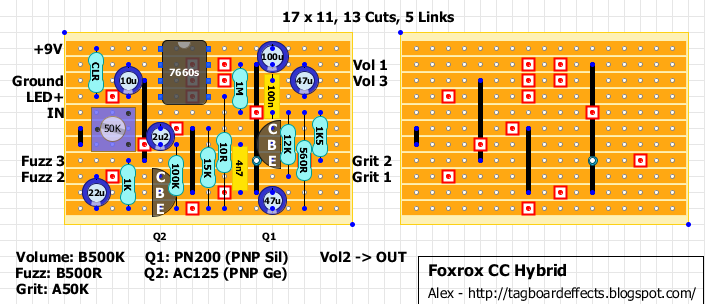
These are 2 separate effects in one box.
Follow Mark's Dual Offboard Wiring.
23/11/2017 Layout Updated! Added the 2 Inputs caps.
Original Info:
"CC Hybrid is one of the first pedals to use one germanium and one silicon transistor in the classic Fuzz Face circuit.
CC
Hybrid is a stand-alone pedal that contains the same Silicon/Germanium
fuzz face circuit as the original Captain Coconut and Captain Coconut2.
To my knowledge, it’s the first example of a commercially available
pedal to use one germanium and one silicon transistor in the classic
Fuzz Face circuit. It combines the warm, dark organic tone of germanium
with the clarity and sustain of silicon. CC Hybrid gives you the best of
both..
Volume - Set the volume you like, compensate for level changes when adjusting the Grit and Fuzz controls.
Fuzz - Controls the amount of gain in the circuit. Typical setting is all the way up, or backed off a little.
Grit
- controls bias voltage to the transistors. This lets you go from
smooth to choppy and everything in between. Typical setting is 11:00.
Past the 2:00 setting the sound takes on a restricted, gated quality.
The extreme range of the Grit control is effected by the voltage coming
into the pedal. Above 9Volts, grit stays smooth at the max setting.
Below 9Volts, grit can sound choppy at gated as low as the 1:00 setting.
If you notice this - don’t worry, there’s nothing wrong with the pedal!
Just set it for the sound you like.
Input trim
- There's a trimmer inside for backing the input level down a little.
Just like having your guitar volume turned down. It’s preset all the way
up."
There are 3 layouts: one with the original trimmer, one with a fixed resistor in its place and one for NPN transistors (not the Foxrox version).