
Showing posts with label Wah. Show all posts
Showing posts with label Wah. Show all posts
Monday, 17 July 2017
Iron Butterfly Fuzz Wah
Not much info on this one, not even who actually made it. Found the schematic years ago over at DIYSB where it was reversed with the help of none other than dino. Figured I'd tale a shot at a vero since I did so many other wahs.


Wednesday, 5 April 2017
Jen Double Sound Fuzz Wah
Couldn't really find a good description of this pedal other then it's a Fuzz-Wah produced in the 70's by Jen. Here's my take based on the schematic. Just like many of the other fuzz wahs I've seen and working on layouts for this is essentially a classic inductor wah with a fuzzface type fuzz. There's a few differences I've noticed compared to a lot of the others. First, there is no control over the amount of output of the fuzz, ie it's set. Second, unlike a lot of the others this one has the fuzz in front of the wah, instead of behind the wah. From the video I found of it, I'm defiantly digging the fuzz and think the component changes gives it a little something different that would be nice as a stand alone fuzz, and the wah has a nice sweep to it as well.

Quick Note: The fuzz should be wired in front of the wah.

Quick Note: The fuzz should be wired in front of the wah.
Tuesday, 4 April 2017
Colorsound Fuzz Wah/Fuzz Wah Straight/Wow Fuzz
The Colorsound Fuzz-Wah, or to be exact the Colorsound Wow-Fuzz! A new version of a funk-tastic old timer. The original 1970’s two transistor silicon distortion stage delivers the fuzz and the classic inductor based Colorsound wah circuit gives you the wow! Ah, the inductor based circuit you say. Been awhile since Colorsound did that, right? That’s right and who better to achieve time machine like accuracy on such a wah circuit than monsieur Castledine of Castledine Electronics fame. From the reproduction circuit board to the custom wound vintage specification inductor, this is a genuine and bona fide Colorsound wah in everyway. The huge soaring sweep, highs that level mountain tops and low mids that sink ships. Fast reacting prono soundtrack like cool, nothing chukka-wah’s like a Colorsound. Buddying up along side this specially falvoured wah circuit we have the authentic fuzz stage as featured in all the early Colorsound Fuzz-Wah’s. Voltage feedback family ahoy. This transistorized silicon fuzz circuit is biased for a smooth and mellow fuzz tone. Rich with heavy density that gels perfectly into the wah stage once engaged.
Independently switchable stages. In other words one switch to engage each circuit. It may seem a little odd at first having both mounted at the front of pedal but it does work surprisingly well indeed. After a little bonding session with the pedal it becomes quite easy to select the circuit you desire or even engage/disengage both simultaneously. It is most certainly not rocket science but a little introductory time is never a bad thing.

You want to use DPDT switches to turn each effect on and off, unless you're going to put LEDs in to see what's on and off, and the wah comes first in the circuit.
A quick note: The original transistors have a pinout of BCE top to bottom on the flat side, but since they can be rather pricey these days I decided to make the layout using the more common CBE pinout. So if you decide to hunt down the original transistors be aware that you will need to twist 2 of the pins. Not a big deal, but can be kind of annoying for those of us that are a little on the meticulous side.
Also, the description I posted is for the Sola Sound reproduction made by the captain. He switched the 5k trimmer to a 47k, so you can put a 50k no problem.
Friday, 17 March 2017
Shin Ei 8TR Fuzz Wah
Can't find much info on a description of it, but what I do know is that it a superfuzz running into a wah. There's literally 1 component value difference in the superfuzz, the rest is straight up identical to the standard superfuzz.

Quick note about the wiring. Just like the Shin Ei 6TR Fuzz Wah I posted the other day, the fuzz comes before the wah, so you'll wire it up according to the dual effect wiring as shown in the offboard wiring tab. You'll notice instead of making this on 1 massive board I opted for 2 separate boards. This will give you more options for placement in an enclosure, by preventing it from being 1 massive board.

Quick note about the wiring. Just like the Shin Ei 6TR Fuzz Wah I posted the other day, the fuzz comes before the wah, so you'll wire it up according to the dual effect wiring as shown in the offboard wiring tab. You'll notice instead of making this on 1 massive board I opted for 2 separate boards. This will give you more options for placement in an enclosure, by preventing it from being 1 massive board.
Thursday, 16 March 2017
Shin Ei 6TR Fuzz Wah
From Retro-Tone Junkie:
This is a very cool and underrated offering from the king of nasty vintage fuzz. This one is Kent branded but has the shin-ei stamp inside. It is widely known that the wah in these is less than desired. This is definitely not a funk machine and you will not channel your inner Hendrix here, but the fuzz really makes up for it. These are 2 transistors short of being an exact superfuzz circuit (TR-8) and in my opinion lie somewhere between the fy-2 and the fy-6.
It has 2 knobs for volume and fuzz adjust, as well as a fuzz tone selector switch that changes from hard to soft. Very much like the superfuzz it basically goes from a scooped, darker sounding tone (soft) to a cutting midrange sound (hard). It also has 2 stomp switches, one of which will turn the fuzz on or off. And one that works just like a standard wah would, employed by the treadle.
I got this pedal for (what I would call) a steal, and these (non-superfuzz) versions can be had for very cheap on ebay or the forums. They are well worth it in my opinion, even though this version is known for a severe volume drop and doesn't meet unity gain in most situations (very much like the fy-2) it sounds really great. This is the chainsaw fuzz your friends warned you about, to me its like the superfuzz without the octave up. I'm glad I chose not to follow the hype and took a chance on this one.
This is supposedly the fuzz tone used by Jesus and the Mary Chain back in the day on Psychocandy.

Quick note about the wiring. The fuzz comes before the wah, so you'll wire it up according to the dual effect wiring as shown in the offboard wiring tab. You'll notice instead of making this on 1 massive board I opted for 2 separate boards. This will give you more options for placement in an enclosure, by preventing it from being 1 massive board.
This is a very cool and underrated offering from the king of nasty vintage fuzz. This one is Kent branded but has the shin-ei stamp inside. It is widely known that the wah in these is less than desired. This is definitely not a funk machine and you will not channel your inner Hendrix here, but the fuzz really makes up for it. These are 2 transistors short of being an exact superfuzz circuit (TR-8) and in my opinion lie somewhere between the fy-2 and the fy-6.
It has 2 knobs for volume and fuzz adjust, as well as a fuzz tone selector switch that changes from hard to soft. Very much like the superfuzz it basically goes from a scooped, darker sounding tone (soft) to a cutting midrange sound (hard). It also has 2 stomp switches, one of which will turn the fuzz on or off. And one that works just like a standard wah would, employed by the treadle.
I got this pedal for (what I would call) a steal, and these (non-superfuzz) versions can be had for very cheap on ebay or the forums. They are well worth it in my opinion, even though this version is known for a severe volume drop and doesn't meet unity gain in most situations (very much like the fy-2) it sounds really great. This is the chainsaw fuzz your friends warned you about, to me its like the superfuzz without the octave up. I'm glad I chose not to follow the hype and took a chance on this one.
This is supposedly the fuzz tone used by Jesus and the Mary Chain back in the day on Psychocandy.

Quick note about the wiring. The fuzz comes before the wah, so you'll wire it up according to the dual effect wiring as shown in the offboard wiring tab. You'll notice instead of making this on 1 massive board I opted for 2 separate boards. This will give you more options for placement in an enclosure, by preventing it from being 1 massive board.
Friday, 10 March 2017
Vintage Wah Extravaganza
Well as promised I've taken the and made layouts for 7 of some of the most desirable vintage wahs. You'll notice that they all look damn near identical, and that's because they're all based on the same circuit with some component differences. So instead of doing my usual description for each, I figured I'll let the videos speak for themselves.
Original Thomas Organ CryBaby

Vox Grey Wah

Vox v847

Shin Ei Wah

Maestro Boomerang BG-1

Maestro Boomerang Wah BG-2
One note about the BG-2 that makes it different from all the others. The switch allows it to go from a wah to a volume pedal.

Colorsound Wah-Wah

Original Thomas Organ CryBaby

Vox Grey Wah

Vox v847

Shin Ei Wah

Maestro Boomerang BG-1

Maestro Boomerang Wah BG-2
One note about the BG-2 that makes it different from all the others. The switch allows it to go from a wah to a volume pedal.

Colorsound Wah-Wah

Saturday, 4 March 2017
Dunlop Dunlop GBC-95 Modded Crybaby
For those that are just never satisfied by whats out there in the land of wahs I took the standard Dunlop GBC-95 Crybaby and added some features based on common mod points. So how's this supposed to work?
Voice Pot: Changes the voice of the the wah by changing the sharpness and making it more "vocal." The larger the value the more "vocal" the wah sounds.
Gain Pot: Really this controls the overall bass and gain of the wah. The lower the value the more growl and bass you'll get.
Sweep Switch (SW): This controls the sweep range of the wah. The larger the cap the more bass sweep you'll get. For instance the common value is 10nF, which i put on the board already, and the bass wah has a 68nF. Personally if I were making this I would start with the stock value and increase using values I liked up to the bass value, but hey, that's just me.
Sweep Pot: This will control the range of the week of the wah pot. No different then what you find on the Dimeback or Cantrell Wah.
R1: This will set the volume of the wah, the smaller the value the more volume you'll get. Typically it's 68k. So you can mess around with it and get as much or as little volume as you liked.

Voice Pot: Changes the voice of the the wah by changing the sharpness and making it more "vocal." The larger the value the more "vocal" the wah sounds.
Gain Pot: Really this controls the overall bass and gain of the wah. The lower the value the more growl and bass you'll get.
Sweep Switch (SW): This controls the sweep range of the wah. The larger the cap the more bass sweep you'll get. For instance the common value is 10nF, which i put on the board already, and the bass wah has a 68nF. Personally if I were making this I would start with the stock value and increase using values I liked up to the bass value, but hey, that's just me.
Sweep Pot: This will control the range of the week of the wah pot. No different then what you find on the Dimeback or Cantrell Wah.
R1: This will set the volume of the wah, the smaller the value the more volume you'll get. Typically it's 68k. So you can mess around with it and get as much or as little volume as you liked.

Friday, 3 March 2017
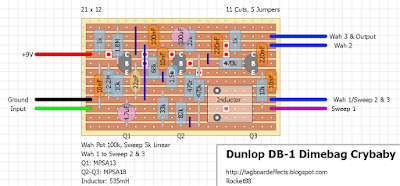
Dunlop DB-1 Dimebag Crybaby
The original Dimebag wah, not the newer one, which will take a while to get done cause the board is completely different and based on the newer Q535 crybaby.

Dunlop JC-95 Cantrell Signature Wah
From the source:
One of the most influential guitarists to come out of the Seattle rock scene, Jerry Cantrell's epic riffs and searing tone have been the driving force behind Alice in Chains since the late 80's. His melancholy wah-drenched melodies in modern classics like "Man in the Box" and "The Rooster" left an indelible mark on a generation of guitarists. Jerry favored wah-wahs with a wider, darker response, and Dunlop has painstakingly replicated that moody sound to create his signature pedal. It's custom-voiced for a tight, punchy heel-down tone and a rugged side-control knob lets you fine tune the toe-down frequency. And with its antique, oxidized "road worn" brass casting and custom Alice in Chains tread, this is one pedal that looks as great as it sounds.

One of the most influential guitarists to come out of the Seattle rock scene, Jerry Cantrell's epic riffs and searing tone have been the driving force behind Alice in Chains since the late 80's. His melancholy wah-drenched melodies in modern classics like "Man in the Box" and "The Rooster" left an indelible mark on a generation of guitarists. Jerry favored wah-wahs with a wider, darker response, and Dunlop has painstakingly replicated that moody sound to create his signature pedal. It's custom-voiced for a tight, punchy heel-down tone and a rugged side-control knob lets you fine tune the toe-down frequency. And with its antique, oxidized "road worn" brass casting and custom Alice in Chains tread, this is one pedal that looks as great as it sounds.

Dunlop ZW-45 Wylde Wah Crybaby
Figured while i was at it, since there are a few signature wahs that are the based on the same board with a few changes, why not just make post a few other layouts.
First up the ZW-45 Wylde Wah.
From the source:
Modern Cry Baby Master Zakk Wylde and Dunlop have joined forces to deliver the toughest, meanest wah pedal on the planet. Built from the ground up with great tone and rugged durability in mind, this pedal can stand up to the crushing stomp of metal's reigning king of lead guitar. The Wylde Wah features a heavy-duty raw-metal casing and road worthy components to withstand years of ass-kicking abuse. With guts that have been finely tuned to Zakk's specs, this wah is specially voiced to deliver an extra thick and cutting tone.

First up the ZW-45 Wylde Wah.
From the source:
Modern Cry Baby Master Zakk Wylde and Dunlop have joined forces to deliver the toughest, meanest wah pedal on the planet. Built from the ground up with great tone and rugged durability in mind, this pedal can stand up to the crushing stomp of metal's reigning king of lead guitar. The Wylde Wah features a heavy-duty raw-metal casing and road worthy components to withstand years of ass-kicking abuse. With guts that have been finely tuned to Zakk's specs, this wah is specially voiced to deliver an extra thick and cutting tone.

Dunlop JH-1 Hendrix Wah
I was asked if I could make a layout for the hendrix crybaby, so here she is. not a whole lot different from a regular crybaby. There are 2 additional caps, resistor change, and different value pot. You may be wondering what these changes do, and in short it moves the sweep range lower.
I have one, it was my first wah, which I got used for $30, and personally I like the lower sweep. I've also compared it with a few others I've built, Colorsound Fuzz Wah and aVox, and I feel there's a nice sweet spot with this one when playing single coils. I know there are those that aren't crazy about it, but hey not everyone has the same tastes.

Thursday, 2 March 2017
Italian Jen Wah Clyde McCoy
Had this sitting in my completed layout folder and completely forgot to post it. The legendary Italian Clyde McCoy Wah from 67-68.


Dunlop GCB-100 Bass Crybaby
Dunlop's classic Crybaby Wah that was modded for use with bass. Not much else to really say about it.


Thursday, 22 September 2016
Madbean Tapanator Projects


Thursday, 31 December 2015
Tycobrahe Parapedal Original
Here's another version of the Tycobrahe Parapedal, but unlike the previous layout, which is apparently a modified from the stock, we had some people in the forum trace an original one, Ciaran posting the schematic before I finished my trace, found here. The only thing different is I added the usual input and output pulldown resistors to prevent any popping.
Original Positive Ground Version

Theoretically, here's the layout but changed to more common Negative Ground

Original Positive Ground Version


Monday, 14 December 2015
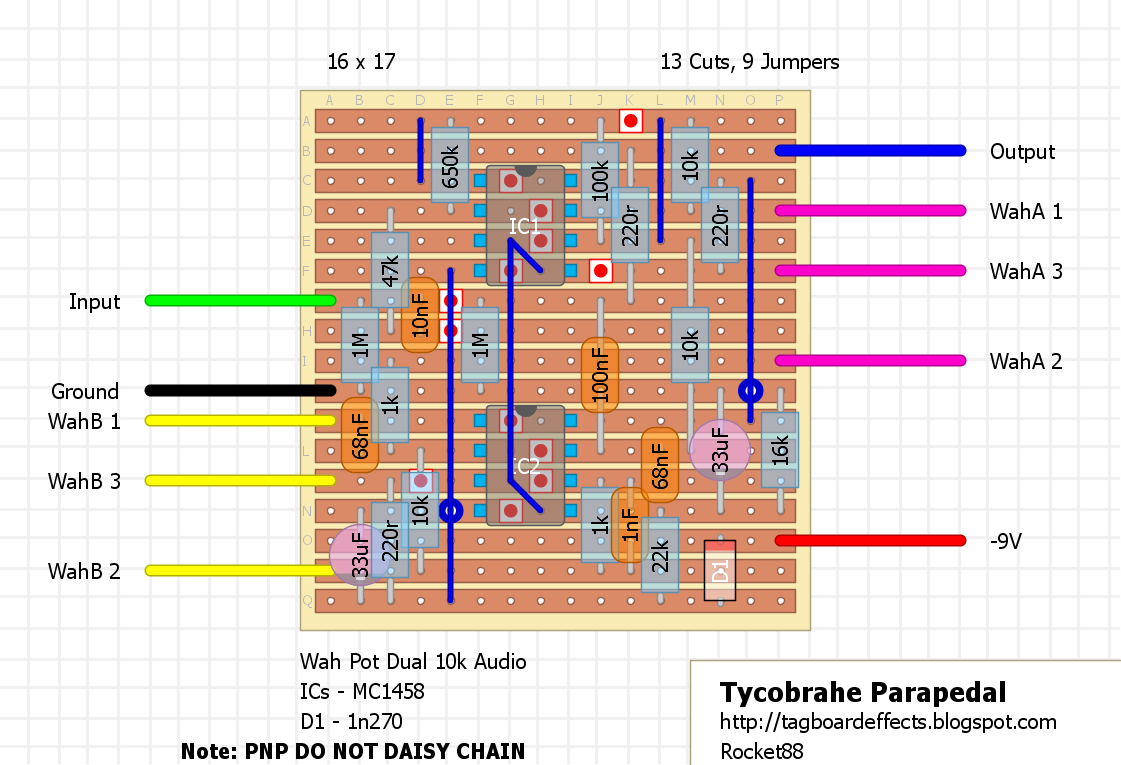
Tycobrahe Parapedal Modified
I saw a request for this effect, and strangely enough I have been looking at making one of these of awhile. Not a whole lot of info on this out there, but here's what I found on the Chicago Iron site about there clone of it.
The Tycobrahe Parapedal was unique in that it used two pots to create it's own incredible wah type sound. The Parapedal was made in the mid seventies by Tycobrahe Engineering and has become quite a collectors item, that is - if you can find one. They were made in such small quantities that their value has sky-rocketed. Ask any vintage effect dealer for one(if they can find one).
What I do know is that Geezer Butler and Tony Iommi both used one, and that's enough of a reason for me to build one. Just listen to N.I.B. and you'll hear it on Geezer's bass solo intro.
Original was Positive Ground:

I also made the few changes to make it Negative Ground so you can daisy chain it:

The Tycobrahe Parapedal was unique in that it used two pots to create it's own incredible wah type sound. The Parapedal was made in the mid seventies by Tycobrahe Engineering and has become quite a collectors item, that is - if you can find one. They were made in such small quantities that their value has sky-rocketed. Ask any vintage effect dealer for one(if they can find one).
What I do know is that Geezer Butler and Tony Iommi both used one, and that's enough of a reason for me to build one. Just listen to N.I.B. and you'll hear it on Geezer's bass solo intro.
Original was Positive Ground:


Tuesday, 2 September 2014
Jim Dunlop CryBaby GCB-95
While I've got the wah template loaded I may as well add this one too :o)
Again thanks to mmolteratx for the schematic.
Info about the original:
When people talk about wah-wah pedals, they’re talking about the Cry Baby Wahs. This is the one that created some of the most timeless sounds in rock. The pedal that would eventually become the Cry Baby was first created in 1966 by engineers at the Thomas Organ Company. This new and expressive effect was an instant hit with players like Jimi Hendrix and Eric Clapton, who have contributed to the Cry Baby Wah’s huge popularity to this day. While other effects have come and gone, the Cry Baby Wah just keeps getting better with age.


Again thanks to mmolteratx for the schematic.
Info about the original:
When people talk about wah-wah pedals, they’re talking about the Cry Baby Wahs. This is the one that created some of the most timeless sounds in rock. The pedal that would eventually become the Cry Baby was first created in 1966 by engineers at the Thomas Organ Company. This new and expressive effect was an instant hit with players like Jimi Hendrix and Eric Clapton, who have contributed to the Cry Baby Wah’s huge popularity to this day. While other effects have come and gone, the Cry Baby Wah just keeps getting better with age.
Sunday, 31 August 2014
Vertex Axis Wah / BBE Ben Wah
I put this on hold because the inductor used has a number of connections and although only 2 of them are being used it may make it difficult to mount on vero. So I will put it on hold and maybe look at doing a daughterboard for the inductor, or maybe even using a different type like a Fasel which will be easier to mount on the vero board. If anyone has any inductors they want to try then post info about them and I'll look at the best way to adapt what you have to this layout with possible just a couple of extra links required.
Update 2: I have changed the layout to incorporate a Fasel inductor for the time being, but will add mods for other inductors as required.
---------------------------------------------------------------------------------------------------------------------
Thanks very much to CodeMonk for all the hard work he put into the degoop and trace. I think most of you will know this story already. Basically Vertex have been selling their Axis Wah for $349.99 and it turns out that it's a verbatim $149 BBE Ben Wah which has been gooped and relabelled despite Vertex claiming they were hand made in the USA with custom wound inductors. They even sell a NOS version which is $50 more, and which has absolutely no NOS components in it, just the same BBE board with a different pot.
So basically it's the modern day Freekish Blues story with the other similarity being that Vertex are another TGP favourite and some people on there with absolutely no self respect will still argue Mason from Vertex's case and not hear a bad word said against him. Amazing how fanboyism can turn some peoples' brains to mush to the point they refuse to acknowledge the damning evidence staring them in the face.
I love guitar effects, and companies like Vertex and Freekish Blues give the industry a bad name, making it difficult to trust new manufacturers and products on the market for fear that you're being ripped off. Hopefully when Vertex endorsers like Landau realise what company they are associated with, Vertex will go the same way as Freekish Blue. Just beware for Mason's next company popping up in a guitar shop near you!
For anyone who would like to see more info about it you can check out this web site where you can see some of the degoop pics along with a hilarious rebuttal from one of Mason's cranially challenged TGP admirers. Worth a read:
http://www.ripoffreport.com/r/Vertex-Effects-Mason-Marangella/Point-Richmond-California/Vertex-Effects-Mason-Marangella-Desperado-on-Huge-Racks-Inc-and-The-Gear-Page-Decepti-1166892
In next weeks episode. How Vertex's totally gutted and rebuilt (in USA allegedly) Boss volume pedal is in fact a Boss volume pedal with the tuner out components removed [shaking head facepalm smiley required].
Out of respect for the manufacturer who deserves the credit I'll include BBE's marketing first:
Ben Wah is based on a 1967 Class A circuit design that featured the unique Halo inductor. We re-engineered and custom-tuned the Halo inductor and potentiometer to re-create the expressive tones made famous by players like Eric Clapton, Jimi Hendrix and Stevie Ray Vaughn. All components are hand-wired for the ultimate in vintage authenticity
We didn't stop there. Ben Wah adds amazing versatility thanks to its “Harmony” control to help fine tune the Q/peak response. The verdict? Guitar Player Magazine had this to say in a wah roundup article:
...the BBE Wah has the sweetest, most musical voice of the bunch. Its potential to be a first-pick wah for any kind of music earns it an Editors' Pick Award. - Guitar Player Magazine"
and now Vertex's:
The Axis Wah is the finest representation of a 1960's style Wah with a few modern additions. It is designed to produce the most vocal characteristics reminiscent of the classic Wah tones we know and love, yet provide a smooth and rounded top-end that doesn't get too bright. Each unit includes our custom hand-wound HALO inductor, hand-made custom potentiometer, and hand-picked components to give this wah its distinctive voice.
Hmmm sounds similar?

This layout uses a Fasel inductor instead of the Eleca used in the BBE simply because it is more suitable to mount on vero. If you prefer to use the original Eleca then I will do a separate daughterboard that will take into account the pin arrangement in the Eleca

Update 2: I have changed the layout to incorporate a Fasel inductor for the time being, but will add mods for other inductors as required.
---------------------------------------------------------------------------------------------------------------------
Thanks very much to CodeMonk for all the hard work he put into the degoop and trace. I think most of you will know this story already. Basically Vertex have been selling their Axis Wah for $349.99 and it turns out that it's a verbatim $149 BBE Ben Wah which has been gooped and relabelled despite Vertex claiming they were hand made in the USA with custom wound inductors. They even sell a NOS version which is $50 more, and which has absolutely no NOS components in it, just the same BBE board with a different pot.
So basically it's the modern day Freekish Blues story with the other similarity being that Vertex are another TGP favourite and some people on there with absolutely no self respect will still argue Mason from Vertex's case and not hear a bad word said against him. Amazing how fanboyism can turn some peoples' brains to mush to the point they refuse to acknowledge the damning evidence staring them in the face.
I love guitar effects, and companies like Vertex and Freekish Blues give the industry a bad name, making it difficult to trust new manufacturers and products on the market for fear that you're being ripped off. Hopefully when Vertex endorsers like Landau realise what company they are associated with, Vertex will go the same way as Freekish Blue. Just beware for Mason's next company popping up in a guitar shop near you!
For anyone who would like to see more info about it you can check out this web site where you can see some of the degoop pics along with a hilarious rebuttal from one of Mason's cranially challenged TGP admirers. Worth a read:
http://www.ripoffreport.com/r/Vertex-Effects-Mason-Marangella/Point-Richmond-California/Vertex-Effects-Mason-Marangella-Desperado-on-Huge-Racks-Inc-and-The-Gear-Page-Decepti-1166892
In next weeks episode. How Vertex's totally gutted and rebuilt (in USA allegedly) Boss volume pedal is in fact a Boss volume pedal with the tuner out components removed [shaking head facepalm smiley required].
Out of respect for the manufacturer who deserves the credit I'll include BBE's marketing first:
Ben Wah is based on a 1967 Class A circuit design that featured the unique Halo inductor. We re-engineered and custom-tuned the Halo inductor and potentiometer to re-create the expressive tones made famous by players like Eric Clapton, Jimi Hendrix and Stevie Ray Vaughn. All components are hand-wired for the ultimate in vintage authenticity
We didn't stop there. Ben Wah adds amazing versatility thanks to its “Harmony” control to help fine tune the Q/peak response. The verdict? Guitar Player Magazine had this to say in a wah roundup article:
...the BBE Wah has the sweetest, most musical voice of the bunch. Its potential to be a first-pick wah for any kind of music earns it an Editors' Pick Award. - Guitar Player Magazine"
and now Vertex's:
The Axis Wah is the finest representation of a 1960's style Wah with a few modern additions. It is designed to produce the most vocal characteristics reminiscent of the classic Wah tones we know and love, yet provide a smooth and rounded top-end that doesn't get too bright. Each unit includes our custom hand-wound HALO inductor, hand-made custom potentiometer, and hand-picked components to give this wah its distinctive voice.
Hmmm sounds similar?
This layout uses a Fasel inductor instead of the Eleca used in the BBE simply because it is more suitable to mount on vero. If you prefer to use the original Eleca then I will do a separate daughterboard that will take into account the pin arrangement in the Eleca
Sunday, 14 July 2013
Bespeco Weeper Wah/Volume
Simple one transistor wah with even simpler volume pedal wiring. Assuming you have wah enclosures to spare.


Friday, 5 April 2013
Mad Professor Snow White Autowah
I did this as a bit of an experiment. I want to build one and this has always been one of those that would prefer to do on a PCB, but I thought I'd still like to put a layout together to see how small I could get it using my methods and as I have I may as well put the results on here.
At 20 x 29 is may just fit in a 1590B if you aren't using a battery and have the stomp switch mounted right at the bottom, but with it having 4 pots, I think I'd probably opt for a 125B which should be a more comfortable fit.
Avoiding 19 links is another of the reasons why I would prefer a PCB :o)
Info about the great sounding original:
BJF design guitar and bass Auto Wah / Voltage Control Filter pedal
Hand-made in Finland premium quality auto wah pedal.
The SNOW WHITE AUTOWAH (SWAW) circuit is based on a 1991 BJF rack mount remote wah circuit and is tuned like a real wah.
The circuit was redesigned with envelope controls and built into small size pedal.
It has very fast tracking and accuracy rarely found on auto wahs/ envelope filters. With the four knobs you can have total control of the effect.
SWAW works both with guitar and bass and you can fine-tune the pedal to suit your instru-ment, your playing style and your taste of tone.
The pedal has a unique decay control for the filter frequency fall speed. You can set it to be fast for wah effects on every note, or slower for a more traditional auto wah sound.
Like all Mad Professor pedals SWAW is hand made in Finland using only premium compo-nents, to give years of trouble free operation with superb musical tone.
Controls
SENSITIVITY: Sets the filter trigger level, tune this carefully to fit your guitar/bass output and your playing touch.
You can further change the sensitivity from your guitar volume knob while playing.
BIAS: Controls the filter resonance frequency. When Sensitivity is turned fully off the Bias can be used as a sweepable filter.
RESONANCE: Controls the sharpness or Q-factor of the filter.
DECAY: Controls how fast the filter frequency falls back to resting point (that is set with the Bias control). This can be set fast (CW) so you get the wah effect on every note or slow for a more traditional auto wah sound.
PLAYING: Please take time to get used to the controls and as this is a voltage control filter it will react to your playing touch. The envelope control circuit is carefully designed to follow the dynamics of guitar/bass and it might take some time to master the Auto Wah playing technics.
Try also adjusting guitar volume between 8 and 10 to further expand use.

Modded version as per the improvements discussed below in the comments:


Subscribe to:
Posts (Atom)