Here's a collection of vero (stripboard) and tagboard guitar and bass effect layouts that we have put together covering many classic and popular effects in growing numbers. Many of these have been posted on freestompboxes.org, so check that site out for great discussions on building your own effect pedals. Enjoy the builds and please also visit us on Facebook and Twitter
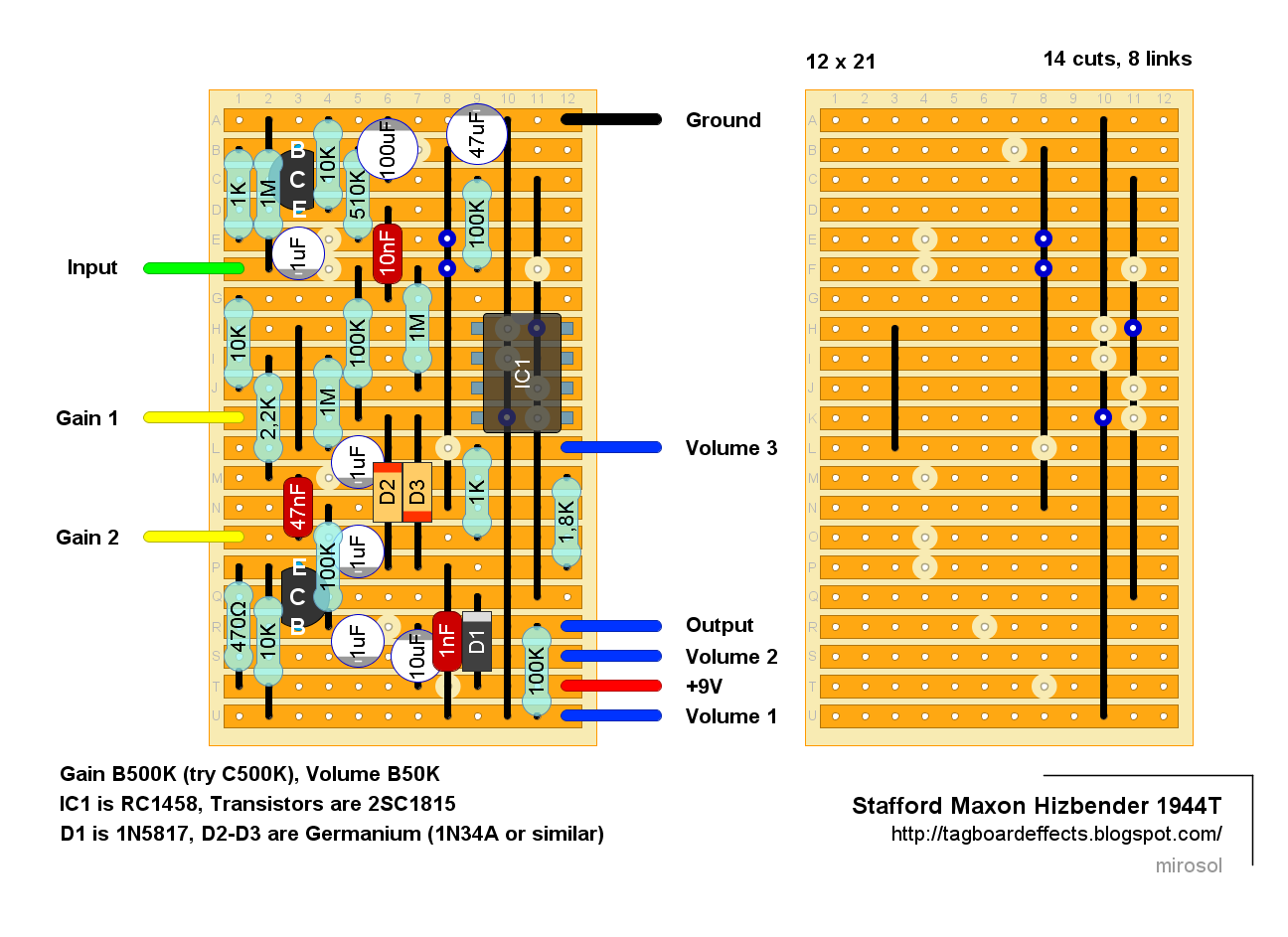
There was a great post from Grey Bench on FSB, tracing this ten year old Stafford Maxon circuit that i found interesting back in a day, but couldn't source a schematic back then. This is per original, using only a half of a dual opamp and utilizing a 12x21 board.
YATS from '94, recycled by Maxon. Asym clippers and slightly lower rolloff frequency for the high pass. Should be a decent alternative for the standard TS.
Originally released in 1979, the Maxon OD808 was one of the first tube-amp overdrive simulators to hit the market. Its smooth, creamy crunch tone caught on quickly, and helped to launch a long line of predecessors as well as imitators. Today, the OD808 design is without a doubt the most used, most imitated and most lauded overdrive circuit of all time. The reason for this is simple tone. Simply put, the OD808 provides the natural, mild overdrive of a tube amp without sacrificing your guitar's original tone. In addition, it can be used as a clean booster to provide increased gain without compromising the sound of your amplifier.
The secret behind the legendary "808 tone" lies in the amplifier section of its circuit. Rather than having an amplifier stage followed by a clipping stage, the Maxon OD808 uses a signal-distorting diode (Panasonic #MA150) that is located in the amplifier stage's negative feedback loop (which also contains the JRC4558 IC chip). Therefore, the Maxon OD808 distorts signal in the amplifier circuit itself which yields a smoother, milder, more natural sounding distortion than a separate clipping stage. This is also the reason that the IC type used in the circuit has such a large impact on the unit's tone. Maxon developed this unique design more than 20 years ago, and while it is commonplace nowadays, back then it was an industry first.
It should be noted that the Reissue Series OD808 uses different output resistors than the original version. After the unit's initial release it was discovered to have a high susceptibility to noise due to static electricity buildup. To improve performance, the positions of the output resistors on the reissue OD808 were reversed and their values increased in order to reduce noise levels. This circuit change has no audible affect on the sound of the unit, save for reducing the noise levels.
Whether it's used as an overdrive or a booster, the Maxon OD808 is the closest you can get to the classic sounds of 1970's rock guitar in a compact effect pedal.
Here's something quite interesting. A switch to toggle between TubeScreamer-like, and a Rat-like mode. Basically this could be the basic tool, think swiss army knife, of overdrives and distortions. I omitted the in/out buffers from the layout, but used the original JFET pinout.
I built the layout, and noticed that with my batch of NE5534s i got lots of squeels in distortion (rat) mode when tone and gain were set high. So i checked it around and noticed that NE5534 do have both, balance and compensation. So i added 3n3 cap for compensation and it worked great - much closer to the demo than with the original one. While i started modding it, i changed tone pot value for 50K linear, as the original 100K's first half was just dull and muddy. Also i think linear taper on the gain pot gives much better feel to it. I must admit that this is very good and versatile circuit. Some of these days i'm going to build two of these and put them in the same box with stomp switches for Dist/ODs as well. Recommended build indeed. So. Here's the modded layout:
Maxon's now discontinued Overdrive / Soft Distortion pedal. Brother to the very popular OD820 and in the same series with the same size case. This layout uses two dual opamps instead of the 3 singles in the original to keep the layout size down. The equivalent of the LM741 in dual opamp form is probably the LM1458, but it's worth trying this with the other popular dual opamps as well such as the JRC4558, NE5532 and TL072 etc, so you can use your favourite.
Originally released in 1979, the Maxon OD808 was one of the first tube-amp overdrive simulators to hit the market. Its smooth, creamy crunch tone caught on quickly, and helped to launch a long line of predecessors as well as imitators. Today, the OD808 design is without a doubt the most used, most imitated and most lauded overdrive circuit of all time. The reason for this is simple tone. Simply put, the OD808 provides the natural, mild overdrive of a tube amp without sacrificing your guitar's original tone. In addition, it can be used as a clean booster to provide increased gain without compromising the sound of your amplifier.
The secret behind the legendary "808 tone" lies in the amplifier section of its circuit. Rather than having an amplifier stage followed by a clipping stage, the Maxon OD808 uses a signal-distorting diode (Panasonic #MA150) that is located in the amplifier stage's negative feedback loop (which also contains the JRC4558 IC chip). Therefore, the Maxon OD808 distorts signal in the amplifier circuit itself which yields a smoother, milder, more natural sounding distortion than a separate clipping stage. This is also the reason that the IC type used in the circuit has such a large impact on the unit's tone. Maxon developed this unique design more than 20 years ago, and while it is commonplace nowadays, back then it was an industry first.
It should be noted that the Reissue Series OD808 uses different output resistors than the original version. After the unit's initial release it was discovered to have a high susceptibility to noise due to static electricity buildup. To improve performance, the positions of the output resistors on the reissue OD808 were reversed and their values increased in order to reduce noise levels. This circuit change has no audible affect on the sound of the unit, save for reducing the noise levels.
Whether it's used as an overdrive or a booster, the Maxon OD808 is the closest you can get to the classic sounds of 1970's rock guitar in a compact effect pedal.
Klon killer? Some people think so, but whatever it's certainly a great sounding overdrive.
Info about the original from Maxon:
While many consider the OD808 to be the greatest overdrive ever created, Maxon is not a company to rest on its laurels. Instead of basking in the glowing praise, Maxon has focused on the user's feedback to come up with an all-new overdrive circuit that addresses the key shortcomings of other units - the result is the OD-820 Overdrive Pro.
The OD-820 was designed to provide a wide range of tube-amp overdrive tones as well as a transparent, hi-gain clean boost. As the name implies, the OD-820 was intended for use by professional guitarists with advanced playing techniques. The OD-820's expressive tone reproduces fingering and picking nuances with haunting precision, making the best use of any guitar or amplifier's character. With a full-frequency response, minimal compression and zero tonal coloration, the OD-820 won't mask a player's performance weaknesses like other overdrives can.
One of the key ingredients to the OD-820's amazing sound lies in its power section. While the OD-820 accepts 9 volts coming in, it then uses a DC-DC voltage converter (#MAX1044) to bump this up to 18 volts. This higher voltage allows for a more accurate, full-frequency reproduction of the input signal than other units can provide. This higher voltage also allows for more balanced powering of the circuit, providing stabilized positive and negative DC voltage to the overdrive, blend, and tone sections of the circuit.
Overdrive and Blend? That's right the other secret weapon of the OD-820 lies in it's blending of distorted and non-distorted signal to create its massive tone. The OD-820's Drive knob does double duty, controlling both the amount of gain and the balance between distorted and non-distorted signal. Note that we said non-distorted signal rather than dry signal this is because this signal is still processed through the tone section of the OD-820's circuit before reaching the output. So, at the lowest Drive settings only non-distorted signal is sent to the output, providing the OD-820's stunning clean boost tone.
Like the OD808, the OD-820 distorts signal in the amplifier section of the circuit rather than having a separate clipping stage, which provides a smoother, more realistic tube-like overdrive than other methods. The higher voltage supplied to the amplifier section provides slightly more clipping than the OD808 or OD-9. The OD-820 uses only JRC4558 op amps for the warmest overdrive tone possible.
And a version using a modified gain pot arrangement (described in the comments below), using two independent pots for the gain control, now labelled Gain and Clean and put together by John. Increasing the Gain pot to 500K will give you quite a bit more dirt out of this version.
This is an awkward one to do a layout for because there seems to be so many schematics out there that the best one is always going to be a matter of personal preference. The original used one half of the opamp for the effect, and the other half for the bypass buffer, with a transistor buffer at the beginning and end of the circuit. This layout is based on the GGG schematic which has an input buffer only and because the layout is designed for use with a 3PDT true bypass switch it ignores the bypass buffering and so only uses one half of the opamp.
Video of rudeez's build:
Here is the version with transistor input and output buffers:
Both should fit comfortably in a 1590B.
Many people have reported good results without the output buffer, and so it may be worth trying the most simple option first to see if you're happy with it.
There are so many ways you could do this. Omit both transistors and use one half of the opamp as the input buffer with no output buffer. Have a transistor input buffer and the unused side of the opamp being used as an output buffer etc etc. The possibilities are endless.
Possible mods that have been suggested, if you find the effect muddy then consider swapping the 22u and 47u caps for 220n and 470n respectively (some people believe the 47u is definitely wrong and was actually .47u and just misread). It may be worth socketing those caps so you can experiment. Some people have reported that the 220p cap should in fact be 1n, but others have said it sounds better with that cap omitted entirely, so again it may be worth socketing so you can swap and remove to test. Suggested improvements to the tone control is to swap the 27n cap for 33n, and swap the 100n cap connected to Tone 1 to 47n. Socket and see.