Showing posts sorted by relevance for query Booster. Sort by date Show all posts

Wednesday, 22 February 2012

Mad Professor Ruby Red Booster

A nice versatile booster here by Bjorn, with switchable buffered or true bypass switching.  I have kept the buffer separate so those who just intend to use it true bypass don't have to bother with the extra components or board size.

Manufacturers info:

BJF design guitar booster/treble booster pedal with master volume

Mad Professor Ruby Red Booster (RRB) is a combination of two boosters and a switchable buffer.

The two boosters are based on the much sought after BJF Little Red Trebler and Red Rooster Booster, connected in that order and with a master volume control.

The RRB can be used as a treble booster, a clean boost or an overdrive unit or any combination of the above. Inside the pedal there is a switch for a high quality buffer. You can set the pedal for true bypass mode or "buffer on" in bypass mode. The Treble Booster is a fine-tuned booster for just the right treble frequency with carefully designed bandwidth and an optimized slope of bass cut.

The booster circuit is designed to overdrive the amplifier inputs from nice shimmer to heavy overdrive, thanks to the massive 40dB of boost. The booster is tuned so that it produces musical distortion by itself on higher boost settings.

You can control the total level of the two boosters with the Master Volume control and also use the Master Volume to achieve distortion from the unit.

The easy to use Mad Professor Ruby Red Booster must be the most versatile high quality booster on market. Build the Mad Professor way: small footprint and big tone.


Thursday, 1 May 2014

Fire Custom Shop Power Booster

Request for this very nice sounding and versatile booster from a Brazilian pedal builder Fire Custom Shop.  The switch selects between clean and dirty mode.  In dirty mode it puts diodes in the feedback loop of a non-inverting amplifier, and changes the frequency response of the high pass filter at the stage.  Following that is an active Baxandall tone stack and finally a buffer stage. Should give a nice boost in a wide range of frequencies.

Info about the original:
Power Booster is designed to be a different kind of booster pedal, which could be used both as booster of gain, as volume booster and to be even more perfect in your setup included two stages of equalization, a control for bass and another control for the treble, as well as key Clean/Dirt which opens a universe of sounds.

You will be surprised with the countless ways to improve and/or modify their timbres. Try all these possibilities with the Power Booster.


The video demo is in Portuguese but the playing is international :o)


Saturday, 23 March 2019

ThroBak Strange Master

From the Source:

The Strange Master treble booster now includes both Germanium and Silicon transistors. These transistors are switchable so the user can now get classic Dallas Rangemaster treble booster Germanium tones and higher gain Silicon treble booster tones from one pedal!

ThroBak guitar effects pedals offers another classic Signature Sound effect with the Strange Master Treble Booster, a recreation of the Germanium Dallas Rangemaster Treble Booster used by Eric Clapton, Brian May and Tony Iommi.

In keeping with our ThroBak Guitar effects pedals Signature Sound philosophy Strange Master treble booster offers user adjustments to shape the sound of this effect. Jimmy Page, Jimi Hendrix and Brian May had Roger Mayer and Peter Cornish customize their effects to create their own signature sound. We give this control to you.

As far as we can tell we are the only company offering a Dallas Range Master clone with a bias adjustment. This  allows you to change the character of treble boost from loose to tight. Switchable range allows treble boost and mid boost germanium distortion. Recreate the Clapton Beano tone or the singing overdrive of Brian May to the growl of Tony Iommi with this pedal, its all in there.


Basically, the Strange Master is a Rangemaster with a switch allowing you to selecting between 2 input caps (Treble and Full) and another switch to select between transistors (Germanium and Silicon), and a bias pot to adjust the bias either between the germanium and silicon transistors or give it a little grit.

Keep in mind that the gain of the transistors is going to be paramount in getting it to sound good. I would suggest looking for gains in the 100-120 hFE range for the germanium (just like a regular rangemaster), and something around 250 hFE for the silicon. Also you can play with the input and output caps to get more or less bass. You can also change the Hi/Low switch for a pot to give you a sweep between the 2 input caps.


Wednesday, 20 March 2013

Bearfoot Baby Pink Booster

Info about the Bjorn designed original:

The Baby Pink Booster is a booster with clean transparent boost and very fine Line Driver in bypass position. It sports adjustable and switchable boosts ranging from unity to approximately 8 times or +18 dB, which is the practical limit with the signal levels and supply voltage range used in conventional effects-empirically derived.

Baby Pink Booster was designed to do just the transparent natural clean boost, there is no overdrive or distortion options, to include an overdrive with Clean Boost one would have to compromise one or the other, we recommend Baby Blue OD or Dyna Red Dist for distortion. The unit doesn't have even Tone knob because it doesn't alter your tone, it just boost your signal and doesn't color your tone at all.

And with it's 180 degree phase bend you can even use it to connect the two channels of your vintage Fender amps (more about this later).

Baby Pink Booster doesn't have a True By Pass but a very well designed Line Driver (buffered output).
It is good to have one pedal with buffered output or you would loose some signal and high end even with best cables if you drive two cables and few short one between pedals.


Original version:


True Bypass with Boost/Buffer toggle switch:


Tuesday, 7 August 2012

Catalinbread Naga Viper

I like the small ones, they only take 5 minutes, and I bet it isn't much longer than that until someone verifies it! :o)

Info from Catalinbread about their original:

The Naga Viper is a booster in the grand old tradition of the Dallas Rangemaster "Treble-Booster".  The Rangemaster has been used by many influential British guitarists including Tony Iommi, Brian May, Marc Bolan, and KK Downing and Glen Tipton of Judas Priest.  These guitarists, while completely unique in their styles, share the Rangemaster secret of boosting their cranked tube amps into a juicy, harmonic-laden rock tone that always cuts through the mix.

The Naga Viper is our version of this famous circuit and it enhances the classic circuit with the addition of two extra controls - Range and Heat.  The original Rangemaster had just one control - Boost.  The Range knob is a continuous control allows you to go from classic treble-boost to a full-range boost and anywhere in-between.  The original could only function as a "treble-booster".  The Heat knob gives you control over the gain level, unlike the original which was fixed at maximum gain.

Why a "treble-booster"?  Well, it is not like merely turning up the treble control on an EQ pedal.  Besides enhancing treble response, it adds its own subtle harmonic distortion and gives you a lot of "push" to really saturate the front-end of your tube amp.  But remember, the Naga Viper has a Range control that allows you to dial in exactly what frequencies get boosted.

The traditional way to use a treble-booster is to plug it straight into an already cranked and overdriven tube amp like the Marshalls, Laneys, and Voxes the British guitarists used.  Since the amps were already cranked up, a full-range boost would result in a muddy sound with no definition.  That is why we want to boost "treble"!

But in this modern era of electric guitar, many guitarists use overdrive pedals that emulate the sounds of cranked big amps into their smaller combos.  The Naga Viper is carefully voiced to allow you to boost your "amp-in-the-box" pedals too to get those famous juicy, saturated sounds at "reasonable" volume levels!  In particular, the Naga Viper was made to go with our Dirty Little Secret MkII and CB30 overdrives.


Thursday, 20 March 2014

TC Electronic Spark Booster

Another great layout from John for a modern booster pedal from TC Electronic.
Info about the original:

Rooted in Tradition, Aimed at Rebellion

Kick your playing into high gear with Spark Booster, a pedal rocking a completely clean boost and heaps of extra features for a world of tone.

    A whopping 26 dB of boost
    Gain knob for added grit and dirt
    Active EQ and toggle switch for precise tonal shaping

Kickstart Your Tone
With a full 26 dB of boost, Spark Booster delivers the juice you need for highlighting solos and nailing that killer lick or riff.

There’s So Much To Gain
The Gain knob allows you to add just a hair (or heaps) of dirt to your tone vastly expanding your tonal palette. The active 2-band EQ function as a powerful set of tone shaping tools allowing you to sculpt your tone with unprecedented precision.

Total Tonal Control
The active 2-band EQ function as a powerful set of tone shaping tools allowing you to sculpt your tone with unprecedented precision.

The mid-shift toggle allows Spark Booster to focus and amplify all those juicy mid-heavy frequencies that make guitar so great, allowing you to cut through any mix.


Gain
Add a hint of grit and compression to your sound to get the same tone and feel cranking and old tube amp beyond "are you insane?!" to induce ear-bleeding levels of guitar heaven.

Active Bass Knob
extended lows and added tightness at the turn of a knob.

Level
drive amps to peak performance and add body, punch and grit to your gear.

Active Treble Knob
Dark and fat or sweet pristine highs with added sparkle and shimmer - the choice is yours.

Maximum You
TC drive pedals offer true bypass. It simply means that no matter what your setup or situation, they give you optimal signal integrity so the 'you' in your playing shines through with unparalleled clarity and definition.


Saturday, 13 October 2012

Wampler Triple Wreck

Request.  I've done the main board and booster separately so that you could potentially put the main board in a 1590B or preferably a 125B (5 pots and a switch are totally do-able in a 125B).  If you're more sane than that and want to put this in a 1590BB then you can build the booster on the separate daughterboard or even experiment with the booster of your choice.  It has been mentioned that this really benefits from an 18V supply, so consider adding a little charge pump daughterboard in there too, with maybe a switch to select between 9V and 18V operation.  As noted by John, leave the booster at 9V all the time, 18V for main board only.

Info from Brian about his excellent original:

The Triple Wreck high gain distortion pedal... When this pedal was thought of, it was decided that we would take no prisoners, we would produce a pedal with so much gain it would wipe the floor of anything else

This pedal is probably one of the tightest, thickest highest gain distortions you have ever heard... Many people have told us that it sounds more like a 5150 amp to them than a distortion pedal, that may very well be - All we know is that Brian designed it to just to be an ass kicking distortion pedal, heavier than everything else, meaner than everything else, and it is.

With a solid three band EQ (total control allowing you to scoop out those mids without it peeking out the lows and highs like so many other pedals) you can emulate some of your favorite high gain tones, but as this pedal is so versatile, you can easily find a distinctive tone all of your own. There is so much control over the tone your distinctive sound is waiting for you. Believe it or not, even when the gain is backed off, this pedal is still useable, it still sounds great.

There are two distinct voices in this pedal, Hard and Brutal. The Hard gives you that warmer thump high gain where as the Brutal allows a little more sparkle to creep in, giving it that more recent, full audio spectrum feel.

So, we've already put in loads of gain, maybe more than you need, so let's stick in a boost switch. What...? Putting a boost switch on an already high gain pedal may sound crazy but you'll be amazed at how well it works. it gives you two options via the Boost Contour blend control. With the boost on and it dialed round to counter-clockwise, your distortion is multiplied and you have the solo sound you have always wanted. Pinch harmonics are just there, in places you've never found them before. With it dialed round to clockwise, your pedal turns into a fuzzy monster... Tweak the EQ and you can get tone that will remind you of the Smashing Pumpkins right round to some Pink Floyd kind of fuzzy solo tone. It's all there, waiting for you.

Think about your favorite high gain tone. Is it a high gain with the mids scooped out, or is it roll your hand across the knobs to get that in your face, fuzzy, brutal attitude-melting distortion. Whatever you are looking for, this is probably the only pedal on the market that can satisfy all of those options. This pedal should come with a public health warning.


Video of rudeez' build:


And as promised with these more complex circuits, here's the BOM from DIYLC2.

Type Value Qty
Capacitors 100n 2
Capacitors 100p 1
Capacitors 100u 1
Capacitors 10n 2
Capacitors 10u 1
Capacitors 1n 1
Capacitors 1u 7
Capacitors 220n 3
Capacitors 220p 3
Capacitors 2u2 1
Capacitors 330p 1
Capacitors 33n 1
Capacitors 470p 1
Capacitors 47n 4
Capacitors 4n7 2
Capacitors 560p 1
Resistors 100K 2
Resistors 100R 1
Resistors 10K 7
Resistors 1K 6
Resistors 1M 3
Resistors 33K 2
Resistors 470K 5
Resistors 47K 5
Resistors 47R 1
Resistors 4K7 1
Resistors 680K 1
Transistors 2N5089 1
IC1 TL074 1
IC2 TL072 1
Diodes 1N4148 5

Thursday, 3 January 2013

Runoffgroove Omega

Continuing with the amazing Runoffgroove library, this time with Omega treble booster. The description below points out that this may be the last treble booster you'll need to build. ROG sound clip is here.

From ROG website:
This project began as a search for a FET treble booster similar to the well-known Dallas Rangemaster. We wanted to overcome several problems associated with building a Rangemaster clone, such as:

Getting a PNP or NPN Ge transistor with low leakage and proper hfe (50-100)
Bias variation with temperature
Poor noise performance (mainly hiss)
In addition, we wanted to retain several features of the original circuit, such as:

Guitar loading
Frequency response
Overall gain
Low output impedance
Non-linear behavior and soft clipping near collector cutoff
A variation of the Fetzer Valve, which we named the High Gain Fetzer Valve or HGFV, allows the accomplishment of all these goals. The HGFV uses a fixed high-valued drain resistor to increase the gain up to 30-35 dB (30-50 times). The drain bias voltage is adjusted by varying the source resistor, which is bypassed by a large capacitor.

During the development we found that varying the input impedance greatly affected the range of boosted frequencies, hence we named this control Range. For best results, the Omega should be driven directly by your guitar.

The output impedance of the HGFV is on the high side, so a MOSFET buffer takes care of driving hard whatever it follows. The gate of this MOSFET is fed from a voltage divider built on the drain resistor of the HGFV stage. This avoids clipping during the lower signal cycle in the output buffer.

The output control could have been named Level or Volume, but we preferred to call it Master to increase the mojo factor.

The resulting circuit is so flexible that it ranges from a treble boost with a slight amount of grit (in fact pretty faithful to a Rangemaster but with less hiss) to a fat overdriven boost (comparable to a gainy LPB-2). In between there are many sweet spots to be found that will correspond to your personal tastes and gear.

The drain bias voltage of the first stage plays a role in determining the character and grit added by the circuit. We encourage you to experiment and find the bias voltage that works best for you. A bias voltage of 7V proved to be faithful to the Rangemaster tones, while a lower drain voltage in the range of 4.5 to 5V was somewhat better for the fat sounds.

We thank Michael Klein who provided the name for this circuit. Omega is the last letter of the Greek alphabet, and we believe this is the ultimate booster. It is also the symbol used to represent ohms, the unit used to measure impedance, and it fits nicely into our circuit since the input impedance is strategically varied to alter the frequency response.


Monday, 1 January 2018

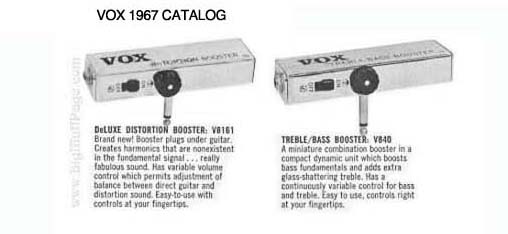
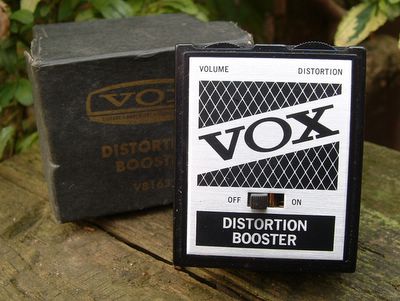
Vox Distortion Booster V8161

First layout of the new year!! Figured we'd start off right with another classic fuzz. The original Vox Distortion Booster is a Fuzz Face variant unlike the reissue, which there's a layout posted. The Vox Distortion Booster V8161 is stupid rare, so no video clips, but being a Fuzz Face variant I'm sure we all have an idea of how it will sound. The Distortion Booster V8161 was made to be plugged directly into your guitar, similar to other effects of the time period.


Monday, 1 October 2012

Xotic RC Booster

Xotic write about their original:

The RC Booster offers a super transparent 20db+ clean boost with an adjustable ±15dB two band active EQ which adds a wide range of harmonic content to your ideal sound. As a clean boost, it can enhance other pedals, such as "overdrive and distortion pedals", or you can crank the gain for a "crunch" sound. But, the RC Booster is an extremely transparent, where many player's find they leave it on all the time.


And you can save a couple of rows if you want to by making up your own diode wrap rather than placing them individually on the board.  If you'd prefer to do that make up two 3-series 1N4148 diodes, wrap them in tape or shrink tube and solder them in as shown below.


Sunday, 13 July 2014

Vox V830 Distortion Booster

Yes. It is big. I've omitted the complex power supply, but left most of the noise reduction measures in tact. Transistor controlled LED circuitry is also gone. With dual gang gain pot and the board size, this will be a tricky but doable fit in 1590B.

Marketing spiel from ten years ago:
Attention: Guitarist who want the fattest distortion. 
Classic distortion, warm tone and high gain. The V830 delivers distortion that goes from 'just enough" to blistering. And its VOX, all analog circuit ensures that your guitar's sound is always warm and natural - no matter what level of distortion you dial in.

Versatile, to fit your style and the way you want to play.
Whether you're into low string riffs on an axe tuned down to D, or paint peeling high notes, the V830's unique design gives you great distortion without losing it's edge and becoming muddy. Even power chords never loose their harmony. The VOX Distortion Booster, for guitar with an attitude!

Three controls - that's all you need. 
The Distortion Booster's DRIVE, LEVEL and TONE knobs give you all the control you need to get the tone you want. It couldn't be any faster or easier to get the sound you need. And, VOX's true-bypass switching ensures that your direct sound is unaltered when you hit the footswitch and bypass the pedal's circuitry.


Monday, 1 January 2018

Vox Distortion Booster V2

Since I just poster the original Vox Distortion Booster, I figured I'd post the second version while i was at it. Just like the V8161 the V2 is also a  Fuzz Face variant. The Vox Distortion Booster V2 is similarly as rare as the V8161, but being a Fuzz Face variant I'm sure we all have an idea of how it will sound.


Friday, 15 July 2016

FYA Garagemaster

This day had to come.

Recently i was asked if i could build a vintage sounding treble booster for modern pedal board. Sure. Why not. And quick looking around showed that there were not that many (!?) rangemaster modernizations around. Or yes there are, but most of them do have something wrong with them - missing vital controls, still using PNP transistors and/or positive ground, sounding too thin or trying to be something completely different, not a treble booster, etc. So i took out the classic Rangemaster schematic and had my way with it. Basics are still there, only with an NPN transistor, large power supply filter cap and a series polarity protection. The switchable input cap is probably the oldest trick in the book, but i tried to voice it so that the frequency response stays at treble boosting area, while still being usable all the way. After all, we're trying to make the best possible treble booster for a modern setup. So to go forward, we got our input pulldown to keep switching POPs to minimum, followed by the "EQ switch" that has a standard 4n7 input cap in circuit all the time, upped by another cap at 2n7 for a fuller frequency response. Transistor also gets its forward bias voltage as the original Rangemaster does, from 470K resistor from supply and 56K resistor to ground. This equals in around 0,958 volts if the supply is at dead 9 volts. Gain is applied by setting the output from between the collector and supply via 10K linear pot. At zero, the output is killed by supply voltage, at maximum the boost amount is enough, or at least enough. This is followed by an output cap (to keep the DC away from the output) that has a slightly bigger value than the original and a another pulldown. Now, what's different in my take on the classic is the "bias" pot. The original Rangemaster would have 3K9 resistor from transistor emitter to ground in parallel with a bypass cap of 47µ value. After a short breadboard session, i settled for 2K7 and a 50K pot in series with it. At maximum, the gain is slightly more than it would be in verbatim Rangemaster clone - and staying clean and soft like a true Rangemaster would. But here's the thing, once we put the 50K+2K7 in parallel with the 47µ, we'll get the misbiased germanium tones ála Hornby Skewes Shatterbox, EHX GeOD and/or Germanium4 Big Muff Pi. If you are familiar with either, you'll know what i'm talking about - that mushroom cloud tone that is both super ugly and yet still pretty cool. The one that makes everythign sound truly broken. In my take of the Rangemaster, i've incorporated a control to set that amount of total destruction to the the classic. This should take you further than a Shatterbox, EHX GeOD and anything else. If not by itself, you should try to boost another pedals with it.

Just finished building a three piece set of these. One for the guy who was asking, one for me and one's for sale. And here's the "factory layout". I hope you are happy with it without a schematic - i just told you what the differences between this and the original Dallas Rangemaster are, so you really shouldn't need one.

The transistor model, gain and leak range- that's one thing i'm keeping a secret. You should be happy with anything - maybe even a 2N3904 could work, if you care to tweak the value of the 2K7.

Oh. The name? The tone of this circuit reminds me a lot of the guitar sounds of the 60s garage bands, such as The Iguanas, The Vistas and so on. Use this circuit to make your modern amplifier sound like the 60s. Yeah. That's the magic in the FYA Garagemaster.

And here are two, more compact versions from Alex. Should be easy fit for 1590A, if you use 9mm pots.


Saturday, 5 May 2012

Keeley Java Boost

Info from Keeley Electronics:

The Java Boost is a germanium based Treble Booster designed to give you classic tones from the 60's and 70's. It is not a clean boost.

It must be used with a cranked amp that is overdriven or distorting a bit already. Cranking the amp and pedal will result in more creamy, beautiful, sustaining distortion with the Java Boost.

The Java Boost is most widely used with a tube amp set to a bit of overdrive or clipping which is the key to getting a great sound from this pedal. Setting the java boost in front of a very clean amp with the volume on 1-2 will surely result in a fairly weak guitar tone! Set the amp for some breakup, then click the Java on. There, you'll have a fantastic sound and see why people rave about the Java Boost.

Features

    * Modern Dallas Rangemaster Circuit
    * 3 way Switched Treble-Booster - Locking 3 way switch so your setting is not moved.
    * Stock Vintage Rangemaster (Center), Mid-boost (Right), and Full Range (Left)
    * Metal film parts for low noise
    * The ULTRA RARE MULLARD OC44 !!!!!!!!!!!!!!!!

The Java Boost is not related to the TS9 or Blues Driver, or any other distortion or overdrive pedal. Boss and Ibanez do not make anything like it!

This product is a Treble Booster by design, not a typical overdrive or distortion pedal. That means, the higher the note played, the more it gets amplified and then, by your amp, distorted. Bass notes get cut in two modes on the Java Boost!

Some people don't have experience with treble boosters. This can make using the Java Boost difficult if you try to use it with a huge power amp that has tons of headroom or doesn't distort easily. The trick to get the Java Boost to outperform any other pedal is to have the right amp settings. The amp should be on the verge of breakup or greater. This is where the wealth of tone will is possible.

Another way to run it is before an overdrive pedal. This is the pedal to get if you want a two pedal overdrive setup. Couple this in front of a TS9 or BD-2 and the results are simply amazing. This will add sparkle and life to your solos like no other pedal can.

So what if your amp is set to super clean?!?! No problem, I've found that I love the Java Boost in front of most other overdrive pedals! Yes, simply use the Java in front of your blues driver, TS, DS, BD, SD, FF type pedal and you get similar results when the standard overdrive pedal is on.


Wednesday, 23 January 2013

Clipper Ship v2

Cool sounding dirty booster from Jon Patton:
Clipper Ship Overdrive. This is a dirty boost cascaded into a FET-based booster (a tweaked version of R.G. Keen’s “SRPP,” based on the AMZ Mini Booster). The gain control goes from clean to fuzzy, but the pedal always cleans up with your guitar’s volume, making it a very open and touch sensitive dirt pedal. And the boost stage has gobs of output to push your amp into its own overdrive. A “stupidly wonderful tone control” allows for treble boost clockwise and treble cut counterclockwise. This build used a Russian germanium transistor for the dirt side and germanium diodes.  The overall character is kind of Vox-y.

Edited notes from the schematic files:
Q1: Any Ge or Si. Germanium with hfe 40-70 sounded best to me and cleaned up well. Q2 & Q3: 2N5457, J201, or other JFET.
Ge1, G2: Diodes should have a Fv < .3v for best performance. Many schotkey diodes will also work great. Red Ge diode prevents temperature changes from affecting the leakage of a Ge transistor. Omit if using a silicon in Q1.
My prototype of version 2.0 used a russian MP38A Ge transistor in Q1 (~61 hfe, leakage ~ 60uA) and Smallbear "Generic" Ge diodes.
This is interesting: ANY transistor will work in Q1 ... including PNP. I can't really recommend using a PNP without more information on why it worked, though.


Monday, 28 June 2021

Bearfoot Honey Beest

Been awhile since a new post on the main site. Life can get in the way, but here's a new one. Keep an eye out for more, we still here and going strong.

From the Source:

Descended from the Honey Bee, this one is capable of more dynamic dirt and quicker and thicker honey. If that’s what you’re after, the Beest can help.

The Honey Beest is an extension of the classic Honey Bee, adding saturation and treble to a much loved design. The heart of the Beest is the addition of a pregain booster controlled by the Pregain knob. The pregain booster is not a simple linear booster, but has an intentional upper mid and treble accent that lets you mix the two gain stages to get just the right saturation and treble. The Nature and Pregain knobs make a wide-ranging EQ section. The Drive and Pregain knobs give full control of the distortion saturation and compression. This also makes the “big bottom” part of the Nature control more useful. Turning the Nature knob full left and the Pregain full right creates a full range overdrive…sort of like if you’ve got a 50-watt 4×12 Supro. 


Tuesday, 7 February 2012

Offboard wiring

A few people have commented on posts asking about offboard wiring.  I use a daisy chained power supply, so for things I build for myself I rarely include a battery snap unless it's a positive ground effect which can't be daisy chained with more common negative ground pedals.

This should help people who may be new to the hobby to see where all the wires shown on my layouts need to go:


This is a less common way of wiring the switch, but it's my favourite method now because it grounds the board input during bypass which will prevent noise bleedthrough that you can get with some high gain circuits.

Dual Effect Example


Switchable Boost

This version shows an optional switchable effect (such as a booster) before the main board.  The main stomp will bypass everything, the second stomp will turn the booster on and off.  If you want the booster after the main effect, solder the input side up as usual and take the main board output to the second stomp instead.


If you want to include a battery snap there are other guides out there such as Beavis Audio's which is excellent.

For pot numbering I stick to this convention:


A lot of the pots I have stocked up on were bought from Futurlec and have PCB pins, so I use this method to solder up the pots which makes it much easier:


A small 5 x 2 piece of vero board is great for this, makes linking pins much easier or even adding the odd component to the pot if it would be convenient to.  Another advantage to this is that the board seems to act like a heat sink so very little heat is transferred to the pot avoiding potential damage.

Need to tame a pedal that is a bit loud with no level control.  Add a simple daughterboard so you can set the level you want and forget it. This is a really small fix and should fit in any build without problem:


Any queries then ask away in the comments.

Thursday, 11 September 2014

ROG Britannia

Here's a challenge for those who want theirs in  1590B. Should fit, but it'll be a challenge.

From ROG:
The English Channel was our first attempt to adapt the Vox AC-30 Top Boost amplifier for use as a guitar pedal. Released in 2004, the English Channel was a straightforward JFET implementation that was heavily based on the amp's schematic using the so-called "FET by numbers" approach. While this approach did certainly capture the amp character to certain degree, the overall sound of the resulting circuit was not as refined as its valve counterpart.

Through the years since the English Channel was released, we've been polishing the manner in which the different valve stages used in guitar amps are adapted to JFET-based circuits. This involves taking several aspects into account, such as the effective frequency response of the stage after considering parasitic capacitances, input and output impedances, gain and dynamic range, and clipping characteristics. Furthermore, in some cases we have taken the artistic license to replace certain portions the circuit with something that provides the intended function without necessarily looking like the original circuit.

Now we present Britannia, a fully redesigned adaptation of the AC-30 for use as a guitar pedal which has been optimized for playing into a clean solid-state amp. We hope that you will find this project a nice approach to the sound that was made famous by many artists, including The Beatles, Tom Petty, The Edge, and Brian May, to name a few, without having to invest in or carry around the real thing.

Here is the usual circuit walkthrough for those interested in the savory details: First, Q1 is our standard high impedance input stage, very "booster friendly" thanks to the two red LEDs at the Gate. Next, you will readily recognize a scaled version of the Gain control section, which together with Q2 form a treble booster. You will also notice that all JFET stages but Q2 are prevented from clipping hard by virtue of the back-to-back diodes present at each Gate. This helps retaining the sweetness and dynamics of the sound. However the original amp has some degree of grittiness in it when pushed hard, and this is achieved specifically by Q2, which is a high gain stage borrowed from the Omega booster. Apart from its higher gain, this stage is generous in 2nd order harmonics. Then comes Q3 as a voltage follower driving a slightly modified version of the original tonestack. Some additional gain is provided by Q4, then a cousin of the original Cut control, which in our case was wired backwards with respect to the original, and therefore labeled Brilliance. Next, the op-amp U1a provides the final touch of soft overdrive, followed by U1b that implements the ultimate toneshaping: a 200 Hz resonance characteristic of a 2x12" cabinet and some high frequency rounding.

Jon Patton's official demo:


Working voltages as posted by ξεναγός νεκρόπολης:

q1
d 6,05
s 0,89
g 0

q2
d 5,06
s 2,42
g 0

q3
c 8,55
b 5,62
e 5,43

q4
d 5,42
s 1,10
g 0


1 4,21
2 4,21
3 3,8
4 0
5 2,09
6 4,21
7 4,21
8 8,43

Saturday, 21 June 2014

Jen Harmon Booster

Not sure what to call this. It has "Booster" written on the original unit, but still i think it's rather closer to an overdrive than a booster. It's definitely not a fuzz. Either way, it does sound pretty nice in the demos. There are other layouts for this circuit around the internets, but i thought i'd be cool to have one that's 1590B friendly. As usual, i've added polarity protection and a filter cap (220µ), to make yours per original, just omit those accordingly. Transistors were BC318C in the original, but i think our closest modern day analogy would be BC549C. Before anyone asks, Input goes to Gain pot's lug number 3.


Tuesday, 5 August 2014

McGillwell FET Booster

Since we're posting tiny circuits today, i thought i'd post a recently traced booster. No input cap, no power filtering or any other modern day trinkets. Tiny booster with outside the box thinking in design. Thanks for trace to Bernardduur at FSB.